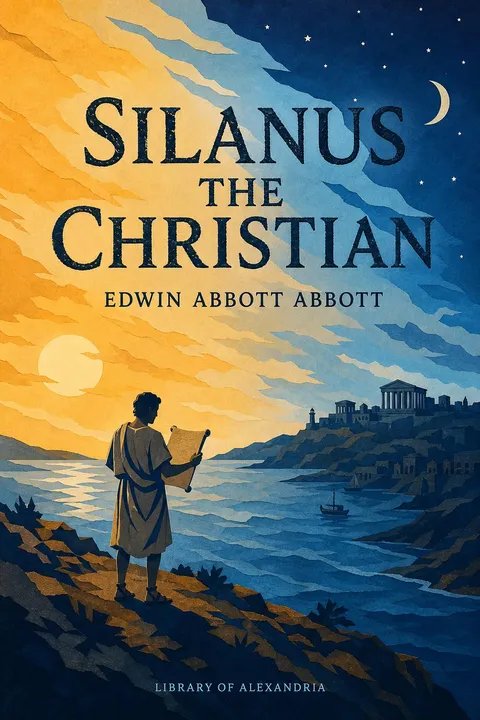
Silanus the Christian
Early Christianity and Stoic Philosophy in a Roman's Search for Faith
Report an issue
Tell us what's wrong and we'll take a look.
Thanks – we got it. We'll review and follow up if needed.
Can faith survive the strongest arguments against it? For one Roman seeker, the path to Christianity begins not with certainty, but with questions.
In Edwin Abbott Abbott's Silanus the Christian, Quintus Junius Silanus looks back in old age, during the reign of Marcus Aurelius, on the intellectual and spiritual journey that changed his life. His recollections begin with the teaching of Epictetus at Nicopolis and lead into a searching encounter with the letters of Paul, the Gospel narratives, and a demanding new understanding of love.
Much of the novel unfolds through correspondence with Scaurus, an older friend, retired soldier, and classical scholar whose objections to the Gospels are serious and detailed. Differences between the evangelists, accounts of miracles, and questions about the Resurrection all come under scrutiny. Alongside these challenges stand the testimony of Clemens, an Athenian Christian, and Silanus's discovery of the Gospel of John. Abbott turns theological debate into a personal struggle: how can a thoughtful person embrace Christ without silencing historical doubt?
What readers find inside:
- Stoicism and belief - The teaching of Epictetus meets Paul's vision of a life transformed by love.
- A skeptic's challenge - Scaurus examines the Gospel accounts with learning, precision, and persistent doubt.
- A gradual conversion - Silanus's changing convictions emerge through reading, friendship, reflection, and experience.
- The fourth Gospel - The Gospel of John opens a different way of understanding Christ and the meaning of faith.
- The ancient Mediterranean - The Roman and Greek world of the second century provides the setting for an intimate religious search.
This novel will appeal to readers of early Christian historical fiction, those interested in Stoic philosophy, and anyone drawn to thoughtful stories about faith and doubt. Its questions remain close to modern life: what should belief ask of reason, and what can reason alone leave unanswered?
Begin Silanus's journey and enter a conversation in which skepticism is heard and faith must find its own voice.
Edwin Abbott Abbott
Edwin Abbott Abbott (1838-1926) was an author, schoolmaster, Anglican priest, and theologian. Born in London, he excelled at both the City of London School and St. John's College, taking the highest honors in classics, mathematics, and theology. After retiring as the headmaster of the City of London School (a position he earned at the age of 26) in 1889, he dedicated his life to literary and theological pursuits. Beyond expounding on his open-minded approach to theology, he also wrote a Shakespearean Grammar that is still considered to be a central piece of English philology. He is best remembered for his 1884 novella Flatland: A Romance of Many Dimensions, an evergreen piece of proto-Science Fiction that still inspires authors and readers to this day.
More by Edwin Abbott Abbott







Why Readwise Books?
Readwise Books is an ebook & audiobook platform that automatically logs how much you and your friends read, making it fun and easy to read more. Learn more →