Report an issue
Tell us what's wrong and we'll take a look.
Thanks – we got it. We'll review and follow up if needed.
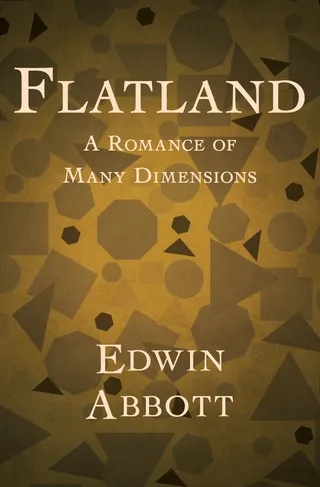
As a satire, 'Flatland' offered pointed observations on the social hierarchy of Victorian culture. However, the novella's more enduring contribution is its examination of dimensions: Noted science writer Isaac Asimov described 'Flatland' as "The best introduction one can find into the manner of perceiving dimensions." As such, the novella is still popular amongst mathematics, physics and computer science students. The story is about a two-dimensional world referred to as Flatland. The unnamed narrator, a humble square (the social caste of gentlemen and professionals), guides us through some of the implications of life in two dimensions. The Square has a dream about a visit to a one-dimensional world (Lineland), and attempts to convince the realm's ignorant monarch of a second dimension, but finds that it is essentially impossible to make him see outside of his eternally straight line.
Edwin Abbott Abbott
Edwin Abbott Abbott (1838-1926) was an author, schoolmaster, Anglican priest, and theologian. Born in London, he excelled at both the City of London School and St. John's College, taking the highest honors in classics, mathematics, and theology. After retiring as the headmaster of the City of London School (a position he earned at the age of 26) in 1889, he dedicated his life to literary and theological pursuits. Beyond expounding on his open-minded approach to theology, he also wrote a Shakespearean Grammar that is still considered to be a central piece of English philology. He is best remembered for his 1884 novella Flatland: A Romance of Many Dimensions, an evergreen piece of proto-Science Fiction that still inspires authors and readers to this day.
More by Edwin Abbott Abbott





Why Readwise Books?
Readwise Books is an ebook & audiobook platform that automatically logs how much you and your friends read, making it fun and easy to read more. Learn more →