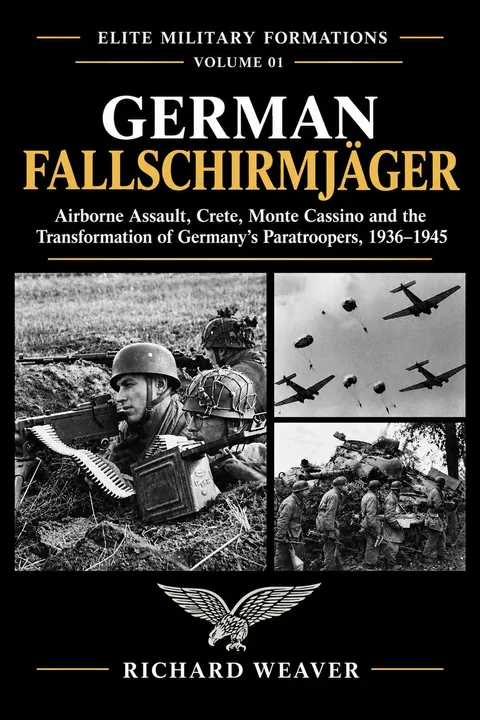
German Fallschirmjäger
Airborne Assault, Crete, Monte Cassino and the Transformation of Germany's Paratroopers, 1936-1945
Report an issue
Tell us what's wrong and we'll take a look.
Thanks – we got it. We'll review and follow up if needed.
An airfield seized in hours could alter a campaign, yet soldiers trained to descend behind enemy lines would spend much of the war fighting on the ground. Their history reveals how innovation, attrition and changing strategic demands transformed a specialist force.
German Fallschirmjäger follows Germany's parachute troops from their first training establishments and the airborne operations of 1940 to the costly victory on Crete, the fighting in North Africa and Italy, and the final campaigns of 1944-1945.
Richard Weaver places the reader inside the decisions that mattered: why particular objectives were chosen, how aircraft and gliders shaped assault plans, what happened when landings went wrong, and how command structures and replacements changed the forces sent into battle.
Inside, discover:
- The creation of German airborne units, their training, weapons and the vulnerabilities built into parachute warfare.
- The operations at Dombås and Eben-Emael, the struggle for Maleme airfield, and the operational cost of Crete.
- The transition to ground warfare, from North Africa to the defensive battles of Monte Cassino.
- The fighting in Normandy and the Ardennes, the expansion of late-war divisions, and the making of the Fallschirmjäger reputation.
Follow the changing relationship between doctrine, battlefield performance and historical memory. By the final chapter, you will be able to distinguish early airborne specialists from later formations and assess their record with greater precision, context and historical understanding.








Why Readwise Books?
Readwise Books is an ebook & audiobook platform that automatically logs how much you and your friends read, making it fun and easy to read more. Learn more →