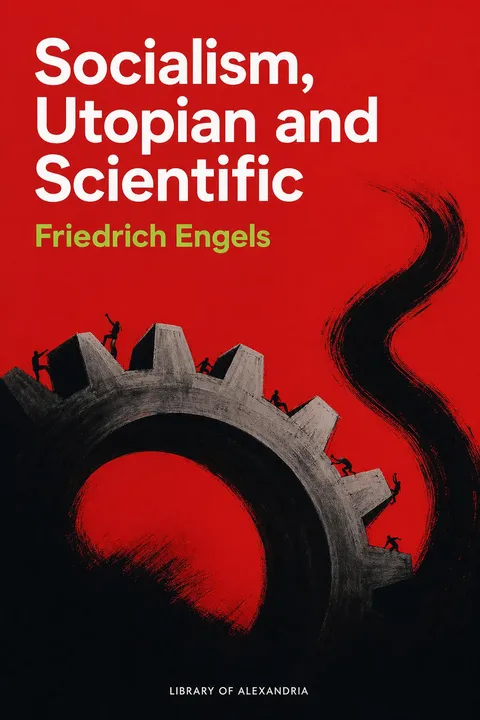
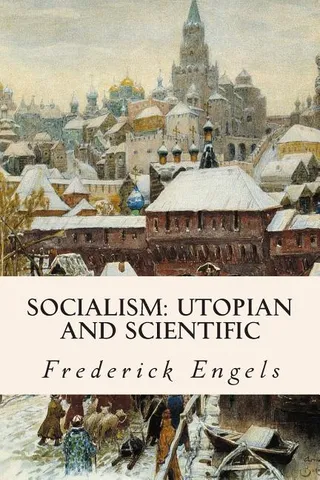
Socialism, Utopian and Scientific
Marxist Theory, Historical Materialism, and the Struggle to Transform Society
Report an issue
Tell us what's wrong and we'll take a look.
Thanks – we got it. We'll review and follow up if needed.
What turns a vision of a better society into a force for historical change?
In Socialism, Utopian and Scientific, Friedrich Engels distinguishes the hopes of early socialist thinkers from an account of social transformation grounded in material conditions. Drawn from his larger critique of Eugen Dühring, these three chapters offer a compact entry into Marxist theory, connecting philosophical argument with the workings of factories, markets, ownership, and class power.
Engels begins with Saint-Simon, Charles Fourier, and Robert Owen, respecting their criticisms of inequality while questioning their reliance on ideal schemes and enlightened goodwill. He then develops historical materialism: the argument that changing forms of production and the social relations around them shape history. Turning to capitalism, he examines the conflict between collective production and private appropriation, recurring economic crises, and the state's role in sustaining class rule. His argument continues to give readers a framework for debating who controls economic life and how societies change.
What readers find inside:
- Early socialist visions - Saint-Simon, Fourier, and Owen reveal both the insight and the limits of schemes for an ideal society.
- Historical materialism - Engels explains social change through productive forces and the relationships that develop around them.
- Capitalism's contradictions - Socialized labor and private ownership come into conflict, producing class antagonism and economic crises.
- State and class power - The state appears not as a neutral referee but as an institution bound up with class conflict.
- Collective control - Engels argues that producers can consciously organize economic forces rather than remain subject to them.
For readers beginning Marxist political theory, students of political economy, and anyone interested in the intellectual history of movements for economic equality, this work brings a consequential argument into sharp focus.
Begin with Engels's central question and follow his case for understanding society in order to transform it.




Why Readwise Books?
Readwise Books is an ebook & audiobook platform that automatically logs how much you and your friends read, making it fun and easy to read more. Learn more →