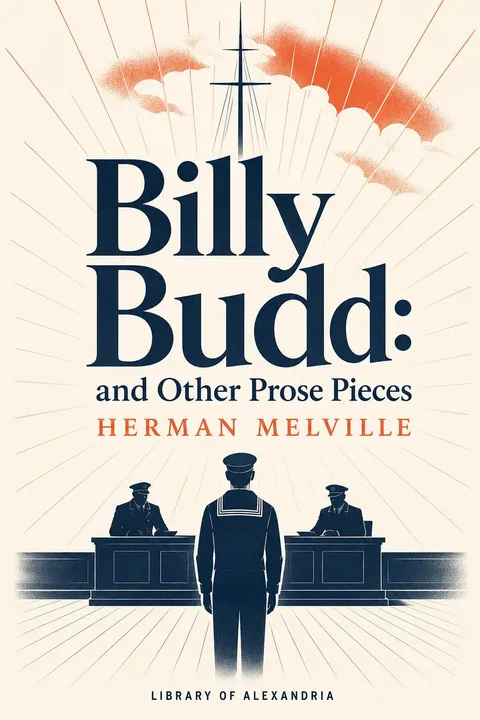
Billy Budd and Other Prose Pieces
Classic Sea Stories of Naval Justice, Innocence, and the Cost of Duty
Report an issue
Tell us what's wrong and we'll take a look.
Thanks – we got it. We'll review and follow up if needed.
What happens when an innocent man becomes a threat to the order he serves? Aboard a British warship, goodness and justice are not always on the same side.
At the heart of Billy Budd and Other Prose Pieces is Herman Melville's haunting novella of a young sailor caught in the machinery of naval discipline. Serving aboard HMS Bellipotent, Billy draws others to him through his beauty and guileless nature. But an unjust accusation brings him into a tragic conflict with authority, and his fate forces those around him to confront the distance between moral judgment and military law.
Through Billy, the hostile master-at-arms John Claggart, and Captain Vere, Melville gives human form to questions that resist simple answers. Can a commander honor his duty without betraying his conscience? Can an institution preserve order and still recognize innocence? Alongside the central novella, the accompanying prose pieces extend the collection's interest in human behavior and reflection. Melville's layered symbolism and searching narrative voice make these writings rewarding not only as stories, but as encounters with the contradictions of power, responsibility, and belief.
What readers find inside:
- Innocence under pressure - Billy's trusting nature meets a world shaped by suspicion, hierarchy, and punishment.
- Naval authority - Life aboard a warship places individual lives beneath the demands of discipline and command.
- Conscience and duty - Captain Vere's dilemma exposes the painful divide between personal conviction and official responsibility.
- Moral ambiguity - The story tests the reader's assumptions about guilt, justice, and the meaning of goodness.
- Symbolic storytelling - Melville turns encounters at sea into searching reflections on human nature.
For readers of classic maritime fiction, admirers of American literature, and anyone drawn to stories of ethical conflict, this collection offers much to consider and discuss.
Step aboard and encounter a story whose hardest questions remain unsettled long after the final page.
Herman Melville
Herman Melville was born in 1819 in New York City. After his father's death he left school for a series of clerical jobs before going to sea as a young man of nineteen. At twenty-one he shipped aboard the whaler Acushnet and began a series of adventures in the South Seas that would last for three years and form the basis for his first two novels, Typee and Omoo. Although these two novels sold well and gained for Melville a measure of fame, nineteenth-century readers were puzzled by the experiments with form that he began with his third novel, Mardi, and continued brilliantly in his masterpiece, Moby-Dick. During his later years spent working as a customs inspector on the New York docks, Melville published only poems, compiled in a collection entitled Battle-Pieces, and died in 1891 with Billy Budd, Sailor, now considered a classic, still unpublished.
More by Herman Melville




Why Readwise Books?
Readwise Books is an ebook & audiobook platform that automatically logs how much you and your friends read, making it fun and easy to read more. Learn more →