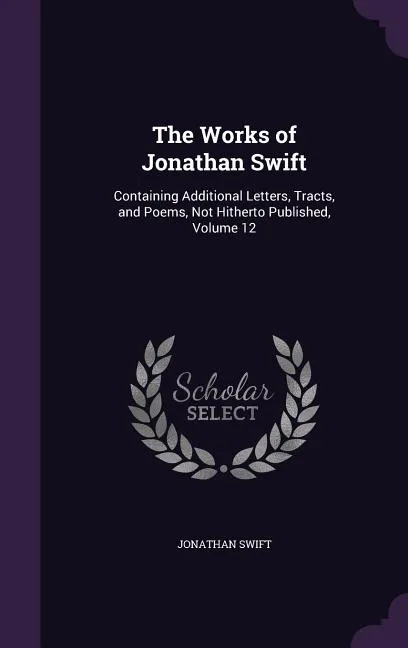
The Works of Jonathan Swift
Containing Additional Letters, Tracts, and Poems, Not Hitherto Published, Volume 12
Report an issue
Tell us what's wrong and we'll take a look.
Thanks – we got it. We'll review and follow up if needed.
This work has been selected by scholars as being culturally important, and is part of the knowledge base of civilization as we know it. This work was reproduced from the original artifact, and remains as true to the original work as possible. Therefore, you will see the original copyright references, library stamps (as most of these works have been housed in our most important libraries around the world), and other notations in the work.
This work is in the public domain in the United States of America, and possibly other nations. Within the United States, you may freely copy and distribute this work, as no entity (individual or corporate) has a copyright on the body of the work.
As a reproduction of a historical artifact, this work may contain missing or blurred pages, poor pictures, errant marks, etc. Scholars believe, and we concur, that this work is important enough to be preserved, reproduced, and made generally available to the public. We appreciate your support of the preservation process, and thank you for being an important part of keeping this knowledge alive and relevant.
Jonathan Swift
Jonathan Swift was an Anglo-Irish satirist, author, essayist, political pamphleteer (first for the Whigs, then for the Tories), poet, and Anglican cleric. He rose to the position of dean of St. Patrick's Cathedral in Dublin, earning him the moniker "Dean Swift." He lived from 30 November 1667 to 19 October 1745. A Tale of a Tub (1704), An Argument Against Abolishing Christianity (1712), Gulliver's Travels (1726), and A Modest Proposal are among Swift's best-known writings (1729). He first published all of his works anonymously or using aliases, such as Lemuel Gulliver, Isaac Bickerstaff, and M. B. Drapier. He was a master of the Horatian and Juvenalian satirical genres. His writing is deadpan and sardonic, especially in "A Modest Proposal", which is why such satire has come to be known as "Swiftian." On November 30, 1667, in Dublin, in the Kingdom of Ireland, Jonathan Swift was born. He was the only son and the second child of Frisby on the Wreake residents Jonathan Swift (1640-1667) and Abigail Erick (or Herrick). After 1700, Swift lived in Trim, County Meath. Many of his works were written by him at this time. Swift graduated with a Doctor of Divinity degree from Trinity College Dublin in February 1702.
More by Jonathan Swift



Why Readwise Books?
Readwise Books is an ebook & audiobook platform that automatically logs how much you and your friends read, making it fun and easy to read more. Learn more →