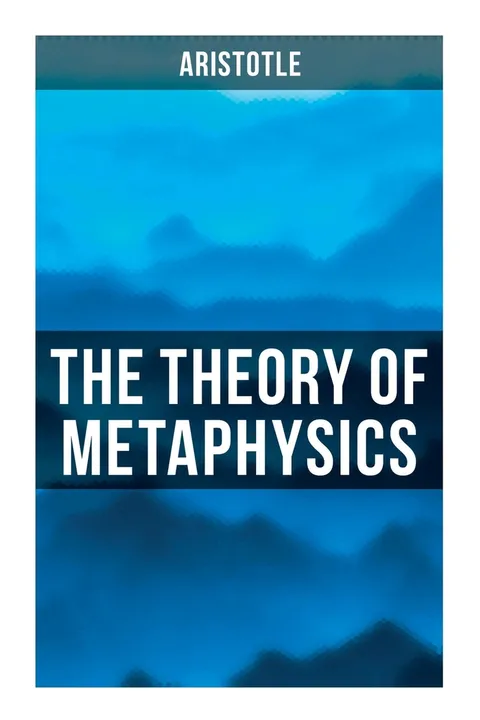
Aristotle: The Theory of Metaphysics
Report an issue
Tell us what's wrong and we'll take a look.
Thanks – we got it. We'll review and follow up if needed.
In "Aristotle: The Theory of Metaphysics," Aristotle delves into the intricacies of existence, substance, and the nature of reality, establishing a foundational text that shapes philosophical discourse. Through a dialectical approach, Aristotle employs a rigorous analytical style, painstakingly dissecting concepts such as being, causality, and the essence of things. This work emerges within the rich tapestry of ancient Greek philosophy, responding to and refining ideas from predecessors like Plato while paving the way for subsequent philosophical inquiry, thus standing as a cornerstone in metaphysical thought. Aristotle, a polymath educated in the philosophical traditions of Socrates and Plato, synthesized empirical observation with abstract reasoning, greatly influencing diverse fields such as science, ethics, and politics. His experiences in the Lyceum and mentorship under Plato exposed him to critical philosophical debates of his time, fueling his desire to understand the foundational principles that govern all entities. This scholarly journey reflects Aristotle's unwavering quest to comprehend the nature of reality and knowledge itself. For students, scholars, and anyone intrigued by the depths of existence, "The Theory of Metaphysics" serves as an essential guide to understanding fundamental philosophical inquiries. Aristotle's meticulous exploration encourages readers to reflect on the principles that underpin their own existences, making this text not only a historical artifact but also a timeless resource for modern philosophical reflection.
Aristotle
Aristotle (384 BC-322 BC) He was an ancient Greek philosopher and scientist whose thought determined the course of Western intellectual history for two centuries. In 335, he established his own school in Athens, the Lyceum. His intellectual range was very wide, covering the greater part of science and various art streams. His ethical and political theory, particularly his concepts of ethical virtues and human growing "happiness," continues to have a philosophical impact. He wrote productively. His major surviving works include the Organon, De Anima's (On the Soul), Physics, Metaphysics, Nicomachean ethics, Eudemian Ethics, Magna Moralia, Poetics, Politics, and Rhetoric, as well as more different works on science and natural history. His father, Nicomachus, was King Amyntas of Macedon's personal physician. Aristotle learned about biology and medical information from his father when he was young. When Aristotle was approximately thirteen, both of his parents died, and Proxenus of Atarneus became his guardian. Although little is known about Aristotle's youth, he most likely spent some time at the Macedonian palace, where he formed his initial links with the Macedonian royalty.
More by Aristotle





Why Readwise Books?
Readwise Books is an ebook & audiobook platform that automatically logs how much you and your friends read, making it fun and easy to read more. Learn more →