Report an issue
Tell us what's wrong and we'll take a look.
Thanks – we got it. We'll review and follow up if needed.
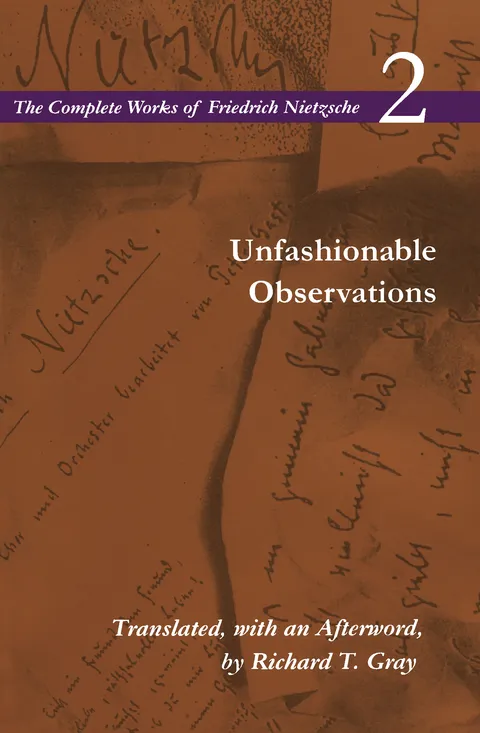
This new translation is the first to be published in a twenty-volume English-language edition of The Complete Works of Friedrich Nietzsche, the first complete, critical, and annotated translation of all of Nietzsche's work. The Stanford edition is based on the Colli-Montinari edition, which has received universal praise: "It has revolutionized our understanding of one of the greatest German thinkers"; "Scholars can be confident for the first time of having a trustworthy text."
Under the title Unzeitgemässe Betrachtungen, Nietzsche collected four essays published separately between 1873 and 1876: "David Strauss the Confessor and the Writer," "On the Utility and Liability of History for Life," "Schopenhauer as Educator," and "Richard Wagner in Bayreuth." The title, newly translated as Unfashionable Observations, spells out the common impulse linking these essays: Nietzsche's inimical attitude toward his "time," understood broadly as all the mainstream and popular movements that constituted contemporary European, but especially German, "culture" in the wake of the Prussian military victory over the French in 1871.
The Unfashionable Observations are foundational works for Nietzsche's entire philosophy, prefiguring both his characteristic philosophical style and many of the major ideas he would develop in his later writings. This is the first English translation to include Nietzsche's variants to the published text.
Friedrich Nietzsche
Friedrich Nietzsche was a German philosopher and author. Born into a line of Protestant churchman, Nietzsche studied Classical literature and language before becoming a professor at the University of Basel in Switzerland. He became a philosopher after reading Schopenhauer, who suggested that God does not exist, and that life is filled with pain and suffering. Nietzsche’s first work of prominence was The Birth of Tragedy in 1872, which contained new theories regarding the origins of classical Greek culture. From 1883 to 1885 Nietzsche composed his most famous work, Thus Spake Zarathustra, in which he famously proclaimed that “God is dead.” He went on to release several more notable works including Beyond Good and Evil and The Genealogy of Morals, both of which dealt with the origins of moral values. Nietzsche suffered a nervous breakdown in 1889 and passed away in 1900, but not before giving us his most famous quote, “From life's school of war: what does not kill me makes me stronger.”
More by Friedrich Nietzsche







Why Readwise Books?
Readwise Books is an ebook & audiobook platform that automatically logs how much you and your friends read, making it fun and easy to read more. Learn more →