Report an issue
Tell us what's wrong and we'll take a look.
Thanks – we got it. We'll review and follow up if needed.
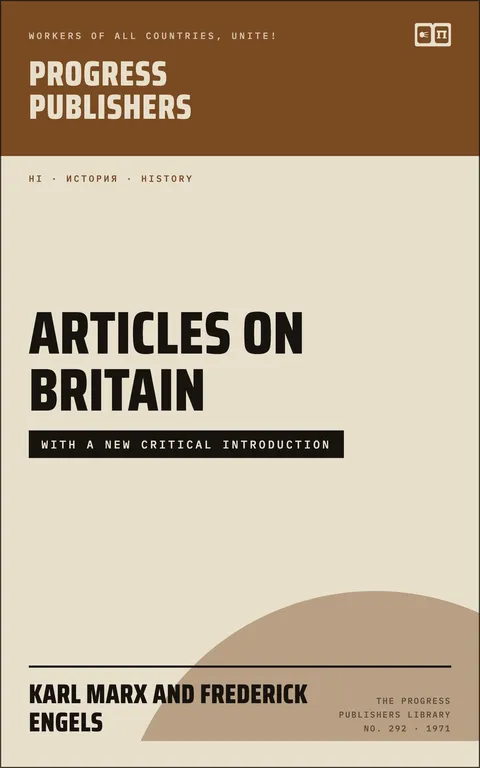
This volume has no preface, and the absence is the most eloquent thing about it. Where the companion Moscow anthologies open with a Publishers' Note explaining what the texts are meant to prove, Articles on Britain offers only the texts: sixty-seven pieces of journalism and occasional writing, from Engels's essays for the Paris Vorwarts in 1844 to his last articles of the early 1890s, followed by the Institute of Marxism-Leninism's two hundred and twenty-two notes and its indexes. With no argument stated on its behalf, the selection is the argument.
Taken as journalism this is Marxism at its most concrete and least systematic, and it is superb. Marx here is a working reporter filing to deadline: on the Sutherland clearances, on the East India Company, on capital punishment, on a "model government" that could jail Irish Fenians in a country of bourgeois freedom. Nothing is deduced from a system; everything is observed. The method holds up where the grander prophecies do not, and the recurrent over-prediction - the English crisis forever about to break - is part of the record too.
At the centre stands one piece that is neither reportage nor prophecy but a discovery. In "England in 1845 and in 1885" Engels asks why, after four decades of the world's most advanced capitalism, England has no socialist movement, and answers that during the period of industrial monopoly the English working class had to a certain extent shared in its benefits - that a layer of skilled workers had won a relatively comfortable position and accepted it as final. "They form an aristocracy among the working class." Decades before the term was current, that is the theory of the labour aristocracy: reformism explained not as a betrayal of ideas but as a material formation.
New critical introduction by Dmitry Chasovennikov, on what that idea does when turned back on the state that reprinted it.
Karl Marx
Karl Marx was born in 1818, in the Rhenish city of Trier, the son of a successful lawyer. He studied law and philosophy at the universities of Bonn and Berlin, completing his doctorate in 1841. In Paris three years later, Marx was introduced to the study of political economy by a former fellow student, Frederick Engels. In 1848 they collaborated in writing The Communist Manifesto. Expelled from Prussia in the same year, Marx took up residence first in Paris and then in London where, in 1867 he published his magnum opus Capital. A co-founder of the International Workingmen's Association in 1864, Marx died in London in 1883.
More by Karl Marx

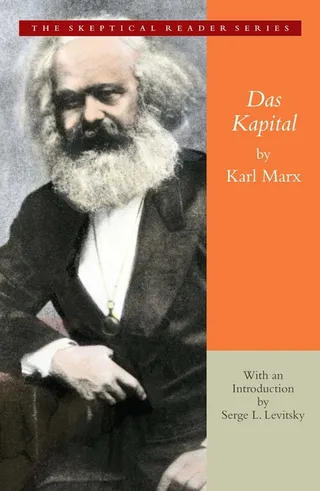
Friedrich Engels
Frederick Engels was born in 1820, in the German city of Barmen. Brought up as a devout Calvinist he moved to England in 1842 to work in his father's Manchester textile firm. After joining the fight against the counter revolution in Germany in 1848 he returned to Manchester and the family business, finally settling there in 1850. In subsequent years he provided financial support for Marx and edited the second and third volumes of Capital. He died whilst working on the fourth volume in 1895.
More by Friedrich Engels



Why Readwise Books?
Readwise Books is an ebook & audiobook platform that automatically logs how much you and your friends read, making it fun and easy to read more. Learn more →