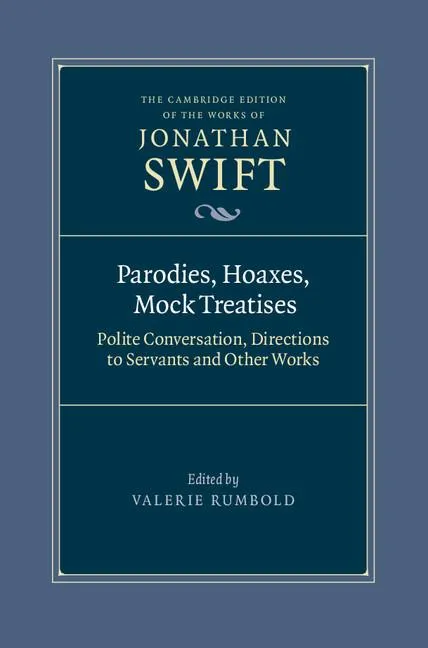
Parodies, Hoaxes, Mock Treatises
Report an issue
Tell us what's wrong and we'll take a look.
Thanks – we got it. We'll review and follow up if needed.
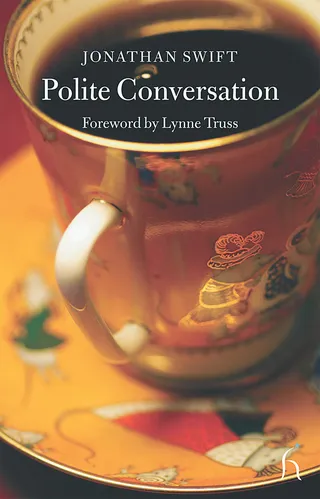
Swift's parodies are among his most fascinating works, but perhaps require most explication for the modern reader. Valerie Rumbold brings a new depth and detail to the editing of Swift's Bickerstaff papers, 'Polite Conversation', 'Directions to Servants' and other works on language and conduct. Highlights include a fresh investigation of the political and print contexts of the Bickerstaff papers, full commentaries on such smaller works as 'A Modest Defence of Punning' and 'On Barbarous Denominations in Ireland', identification and explanation of many additional sayings in 'Polite Conversation', and a detailed contextualisation of 'Directions to Servants' in contemporary domestic theory and practice. A substantial thematic Introduction is supplemented by an individual headnote and full annotation to each work. The Textual Introduction explores the publishing strategies adopted by Swift and his booksellers, and a separate Textual Account of each work presents and discusses changes in the texts over time.
Jonathan Swift
Jonathan Swift was an Anglo-Irish satirist, author, essayist, political pamphleteer (first for the Whigs, then for the Tories), poet, and Anglican cleric. He rose to the position of dean of St. Patrick's Cathedral in Dublin, earning him the moniker "Dean Swift." He lived from 30 November 1667 to 19 October 1745. A Tale of a Tub (1704), An Argument Against Abolishing Christianity (1712), Gulliver's Travels (1726), and A Modest Proposal are among Swift's best-known writings (1729). He first published all of his works anonymously or using aliases, such as Lemuel Gulliver, Isaac Bickerstaff, and M. B. Drapier. He was a master of the Horatian and Juvenalian satirical genres. His writing is deadpan and sardonic, especially in "A Modest Proposal", which is why such satire has come to be known as "Swiftian." On November 30, 1667, in Dublin, in the Kingdom of Ireland, Jonathan Swift was born. He was the only son and the second child of Frisby on the Wreake residents Jonathan Swift (1640-1667) and Abigail Erick (or Herrick). After 1700, Swift lived in Trim, County Meath. Many of his works were written by him at this time. Swift graduated with a Doctor of Divinity degree from Trinity College Dublin in February 1702.
More by Jonathan Swift



Why Readwise Books?
Readwise Books is an ebook & audiobook platform that automatically logs how much you and your friends read, making it fun and easy to read more. Learn more →