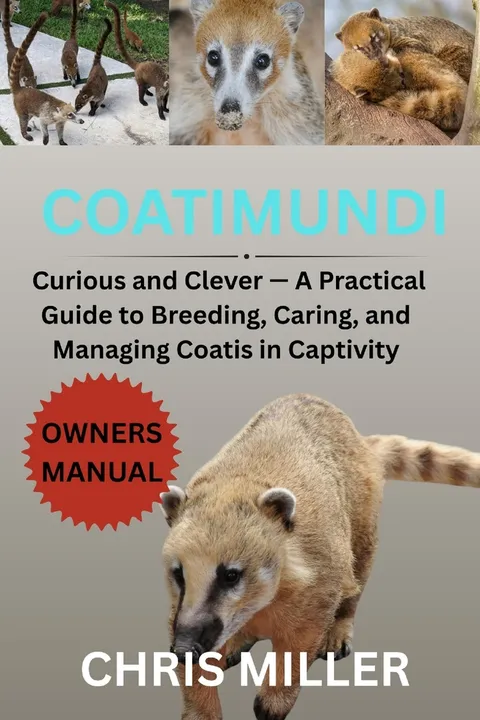
Coatimundi
Curious and Clever - A Practical Guide to Breeding, Caring, and Managing Coatis in Captivity
Report an issue
Tell us what's wrong and we'll take a look.
Thanks – we got it. We'll review and follow up if needed.
Coatimundis serve critical ecological functions as omnivorous foragers within their habitats. Their diet includes insects, small vertebrates, fruits, seeds, and eggs, positioning them as both predators and seed dispersers. By foraging through leaf litter and soil, coatis contribute to invertebrate population regulation and facilitate nutrient cycling. Their seed consumption and subsequent dispersal through fecal matter aid in plant regeneration and forest dynamics.
Socially, female coatis and their offspring form cohesive bands that engage in cooperative behaviors such as communal defense and collective foraging, enhancing survival and reproductive success. Males tend to be solitary outside the breeding season, minimizing intraspecific competition. Coatis also act as prey for larger predators, including jaguars, ocelots, and large raptors, linking trophic levels within their ecosystems.
Furthermore, their extensive ranging behavior promotes habitat connectivity by influencing seed dispersal over wide areas. Their role as ecosystem engineers extends to soil turnover through digging, which affects microhabitat structure and nutrient availability. Thus, coatis are integral to maintaining biodiversity, trophic balance, and habitat complexity across their geographic range.







Why Readwise Books?
Readwise Books is an ebook & audiobook platform that automatically logs how much you and your friends read, making it fun and easy to read more. Learn more →