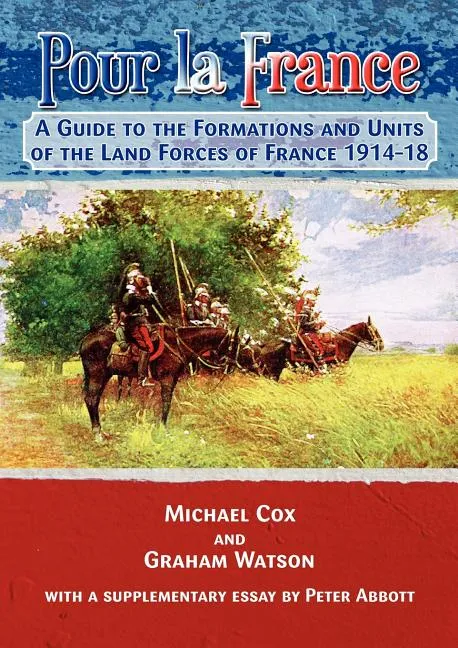
Pour La France
A Guide to the Formations and Units of French Land Forces 1914-18
Report an issue
Tell us what's wrong and we'll take a look.
Thanks – we got it. We'll review and follow up if needed.
For each division, the authors provide a full listing of all the constituent components, whether they were infantry, artillery, cavalry or engineers. This will enable readers to reconstruct the composition of each division on any given date. In addition to a list of commanders, a detailed narrative of its operational history is provided.
This full treatment of the divisions is complemented by a series of detailed lists of all the metropolitan and colonial regiments from which the divisions drew their manpower. These lists cover infantry, artillery, cavalry and engineers. The large number of regiments raised and employed operationally precludes coverage as detailed as that provided for the divisions, nevertheless, a much useful data is provided.
In the second part of the study the authors build on the coverage of divisions and regiments, providing a detailed history of higher formations of the French Army: the army groups, armies and army corps. It is rare to find adequate coverage of such formations for any of the armies of the First World War. The authors hope to remedy this neglect. The higher direction of military operations, especially on the Western Front, was conducted through these three levels of command, which linked the commander-in-chief to the front line divisions and regiments under his command. The French army, at various times, employed four army groups on the Western Front. In addition, it formed 10 armies, a variety of temporary army-level detachments, and 36 corps, plus various temporary corps-level commands.
The coverage of each higher formation includes information on leaders, troops under direct command, and a narrative history, which includes all divisions assigned to the relevant headquarters. From this information the reader can reconstruct the French order of battle for any given date between August 1914 and November 1918.
After an alphabetical listing of French generals, the authors provide an extensive series of orders of battle which includes both overviews of the entire Western Front, such as 11th November 1918, and of individual battles and campaigns such as Verdun in 1916. This coverage includes the French contributions to the Allied cause in Gallipoli, Salonika and Italy.
The book concludes with a guest contribution from Peter Abbott, who provides an overview of the contribution of those forces raised in the French colonies.
Pour la France is destined to become a landmark First World War reference work.
"..is big on detail and will certainly become the standard reference work on the French Army in WWI. The structure of the book is well thought out and easy to access. Required reference material for any serious scholar of the Great War." Out of Battle blog
Michael Cox
The 2010 recipient of the A.C. Greene Award for lifetime achievement, Mike Cox is the author of twenty-one nonfiction books. An award-winning former journalist and longtime freelance writer, he lives in Fredericksburg, Texas, and is a spokesperson for the Texas Parks and Wildlife Department.
More by Michael Cox




Graham Watson
Graham Watson is a specialist in the Brontës and Elizabeth Gaskell, and he is currently researching Victorian literary identities at the University of Glasgow. He has published a number of papers in Brontë Studies and has recently joined the journal’s peer-review board. This is his first book. Graham lives in Glasgow.
More by Graham Watson



Why Readwise Books?
Readwise Books is an ebook & audiobook platform that automatically logs how much you and your friends read, making it fun and easy to read more. Learn more →