Report an issue
Tell us what's wrong and we'll take a look.
Thanks – we got it. We'll review and follow up if needed.
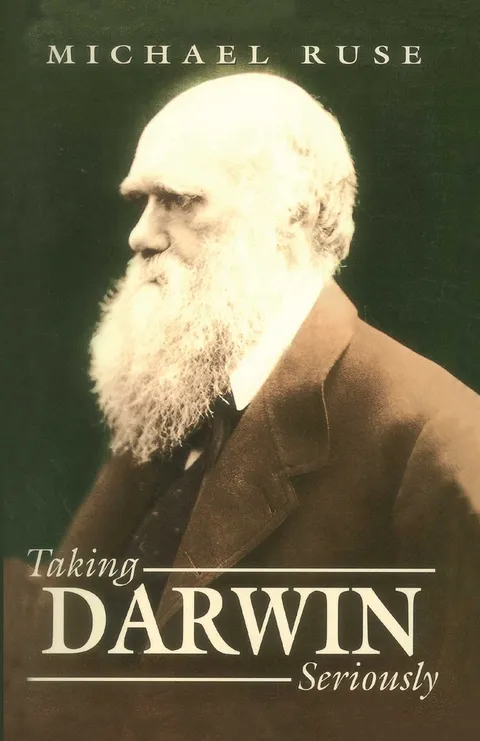
First published a decade ago, Michael Ruse's Taking Darwin Seriously established itself as one of the most important works on evolutionary naturalism since Darwin's own Origin of Species in 1859. Updated with a new preface and final chapter, this timely volume challenges the threadworn arguments as well as the new claims of creationism seeping into mainstream education, science, and philosophy, and reestablishes solid arguments supporting the science of Charles Darwin.Applying evolutionary biology to traditional philosophical problems, this volume establishes a naturalistic approach to our understanding of life's major problems. Ruse argues thoughtfully that to understand the problems of knowledge (epistemology) and of moral thought and behavior (ethics), we must know that we are the end-products of the natural process of evolution rather than the special creation of a supernatural god. At the same time, he warns evolutionists who would fashion an atheistic secular religion from their science.Written in an easy style to interest the professional and the general reader, this book is a pillar of philosophy intended as a direct challenge to all those who would push creationism as a credible alternative to scientific evolution in public schools, universities, and as a general theory of public consumption.
Michael Ruse
Michael Ruse is Professor Emeritus in the Department of Philosophy at the University of Florida. He is the author or editor of over sixty books, including The Darwinian Revolution: Science Red in Tooth and Claw, Monad to Man: The Concept of Progress in Evolutionary Biology, Can a Darwinian be a Christian?, Darwinism as Religion: What Literature tells us about Evolution and On Purpose. Ruse is a fellow of the Royal Society of Canada and the recipient of four honorary degrees.
More by Michael Ruse






Why Readwise Books?
Readwise Books is an ebook & audiobook platform that automatically logs how much you and your friends read, making it fun and easy to read more. Learn more →