Report an issue
Tell us what's wrong and we'll take a look.
Thanks – we got it. We'll review and follow up if needed.
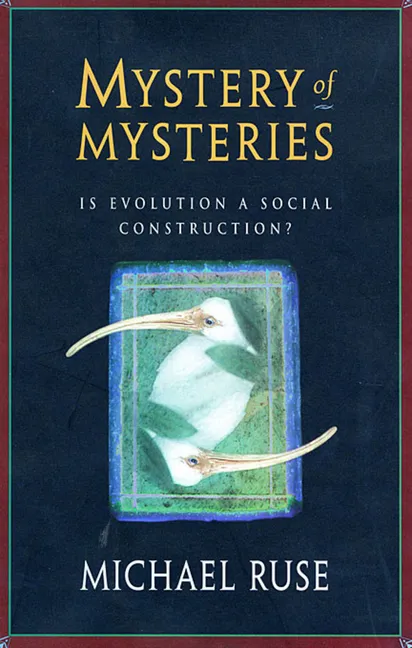
With the recent Sokal hoax--the publication of a prominent physicist's pseudo-article in a leading journal of cultural studies--the status of science moved sharply from debate to dispute. Is science objective, a disinterested reflection of reality, as Karl Popper and his followers believed? Or is it subjective, a social construction, as Thomas Kuhn and his students maintained? Into the fray comes Mystery of Mysteries, an enlightening inquiry into the nature of science, using evolutionary theory as a case study.
Michael Ruse begins with such colorful luminaries as Erasmus Darwin (grandfather of Charles) and Julian Huxley (brother of novelist Aldous and grandson of T. H. Huxley, "Darwin's bulldog" ) and ends with the work of the English game theorist Geoffrey Parker--a microevolutionist who made his mark studying the mating strategies of dung flies--and the American paleontologist Jack Sepkoski, whose computer-generated models reconstruct mass extinctions and other macro events in life's history. Along the way Ruse considers two great popularizers of evolution, Richard Dawkins and Stephen Jay Gould, as well as two leaders in the field of evolutionary studies, Richard Lewontin and Edward O. Wilson, paying close attention to these figures' cultural commitments: Gould's transplanted Germanic idealism, Dawkins's male-dominated Oxbridge circle, Lewontin's Jewish background, and Wilson's southern childhood. Ruse explicates the role of metaphor and metavalues in evolutionary thought and draws significant conclusions about the cultural impregnation of science. Identifying strengths and weaknesses on both sides of the "science wars," he demonstrates that a resolution of the objective and subjective debate is nonetheless possible.
Michael Ruse
Michael Ruse, born (in 1940) in England, taught philosophy for thirty-five years at the University of Guelph, in Ontario, Canada, and then for twenty years at Florida State University. He is an expert on the history and philosophy of evolutionary biology and has written or edited over sixty books. He is particularly interested in the relationship between science and religion, and was a witness for the ACLU in 1981 in its successful attempt to overturn a law mandating the compulsory teaching of Creationism in Arkansas. He has been awarded a Guggenheim fellowship (USA) and a Killam fellowship (Canada). A fellow of the Royal Society of Canada, he has been a Gifford Lecturer and is the recipient of four honorary degrees.
More by Michael Ruse





Why Readwise Books?
Readwise Books is an ebook & audiobook platform that automatically logs how much you and your friends read, making it fun and easy to read more. Learn more →