Report an issue
Tell us what's wrong and we'll take a look.
Thanks – we got it. We'll review and follow up if needed.
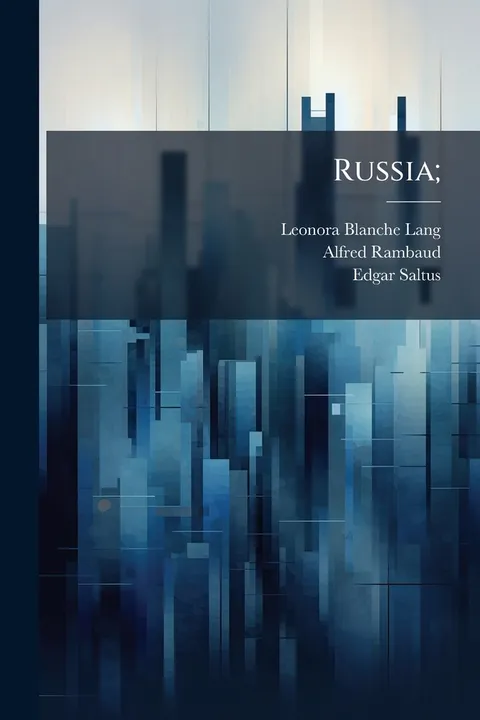
"Russia;" offers a comprehensive overview of Russia, likely from a late 19th-century perspective. Authored by Leonora Blanche Lang, Alfred Rambaud, and Edgar Saltus, the book delves into the historical, political, and social aspects of Russia. Readers can gain insights into the empire's development, governance, and societal structures during a pivotal era. The book likely provides a detailed examination of the Tsarist regime, Russian culture, and the various social strata that characterized the nation. It provides a valuable resource for those interested in understanding Russia's complex past and its place in world history.
This work has been selected by scholars as being culturally important, and is part of the knowledge base of civilization as we know it. This work was reproduced from the original artifact, and remains as true to the original work as possible. Therefore, you will see the original copyright references, library stamps (as most of these works have been housed in our most important libraries around the world), and other notations in the work.
This work is in the public domain in the United States of America, and possibly other nations. Within the United States, you may freely copy and distribute this work, as no entity (individual or corporate) has a copyright on the body of the work.
As a reproduction of a historical artifact, this work may contain missing or blurred pages, poor pictures, errant marks, etc. Scholars believe, and we concur, that this work is important enough to be preserved, reproduced, and made generally available to the public. We appreciate your support of the preservation process, and thank you for being an important part of keeping this knowledge alive and relevant.









Edgar Saltus
Edgar Saltus (1855-1921) was an American novelist, essayist, and critic known for his distinctive style and exploration of themes related to decadence, social critique, and psychological depth. His works often reflect his fascination with the darker aspects of human nature and society. Saltus's literary career is marked by his contributions to the genre of decadent literature, a movement that focused on themes of moral decay, luxury and the exploration of the darker aspects of life. His writing often reflects a fascination with the decline of social and moral values. Some of his notable works include: The Pace That Kills: A Chronicle (1901): A novel that delves into social decadence and moral issues within a wealthy urban setting. It explores the impact of luxury and affluence on personal relationships and societal values. Imperial Purple (1897): A novel set in ancient Rome that reflects Saltus's interest in historical settings and his exploration of moral and social themes. The Lilies of the Field (1905): A work that continues Saltus's exploration of decadence and societal critique through its portrayal of characters and their experiences. Edgar Saltus's contributions to literature are noted for their exploration of decadent themes and psychological complexity. His distinctive style and focus on social critique make his works a notable part of early 20th-century literature. Despite not achieving widespread fame during his lifetime, Saltus's writing continues to be appreciated for its literary qualities and its exploration of societal issues.
More by Edgar Saltus




Why Readwise Books?
Readwise Books is an ebook & audiobook platform that automatically logs how much you and your friends read, making it fun and easy to read more. Learn more →