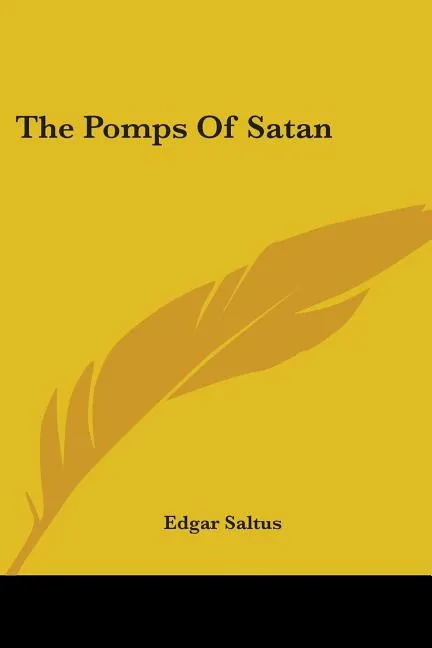
The Pomps Of Satan
Report an issue
Tell us what's wrong and we'll take a look.
Thanks – we got it. We'll review and follow up if needed.
The Pomps of Satan is a novel written by Edgar Saltus, first published in 1895. The book is a Gothic tale that explores the themes of sin, temptation, and redemption. The story follows the life of a young man named Paul Verdayne, who is born into a wealthy family and lives a life of luxury and excess. However, as he grows older, he becomes increasingly disillusioned with his shallow existence and begins to question the meaning of life.One day, Paul meets a mysterious woman named Madame de Medici, who introduces him to a world of dark secrets and forbidden pleasures. She leads him down a path of sin and temptation, and Paul soon finds himself caught up in a web of deceit and corruption. As he becomes more and more entangled in Madame de Medici's web, Paul begins to realize the true nature of his own desires and the consequences of his actions.The novel is a powerful exploration of the human psyche and the struggle between good and evil. Saltus's writing is rich and evocative, with vivid descriptions of the decadent world of the wealthy elite. The Pomps of Satan is a timeless classic that continues to captivate readers with its haunting themes and unforgettable characters.This scarce antiquarian book is a facsimile reprint of the old original and may contain some imperfections such as library marks and notations. Because we believe this work is culturally important, we have made it available as part of our commitment for protecting, preserving, and promoting the world's literature in affordable, high quality, modern editions, that are true to their original work.
Edgar Saltus
Edgar Saltus (1855-1921) was an American novelist, essayist, and critic known for his distinctive style and exploration of themes related to decadence, social critique, and psychological depth. His works often reflect his fascination with the darker aspects of human nature and society. Saltus's literary career is marked by his contributions to the genre of decadent literature, a movement that focused on themes of moral decay, luxury and the exploration of the darker aspects of life. His writing often reflects a fascination with the decline of social and moral values. Some of his notable works include: The Pace That Kills: A Chronicle (1901): A novel that delves into social decadence and moral issues within a wealthy urban setting. It explores the impact of luxury and affluence on personal relationships and societal values. Imperial Purple (1897): A novel set in ancient Rome that reflects Saltus's interest in historical settings and his exploration of moral and social themes. The Lilies of the Field (1905): A work that continues Saltus's exploration of decadence and societal critique through its portrayal of characters and their experiences. Edgar Saltus's contributions to literature are noted for their exploration of decadent themes and psychological complexity. His distinctive style and focus on social critique make his works a notable part of early 20th-century literature. Despite not achieving widespread fame during his lifetime, Saltus's writing continues to be appreciated for its literary qualities and its exploration of societal issues.
More by Edgar Saltus










Why Readwise Books?
Readwise Books is an ebook & audiobook platform that automatically logs how much you and your friends read, making it fun and easy to read more. Learn more →