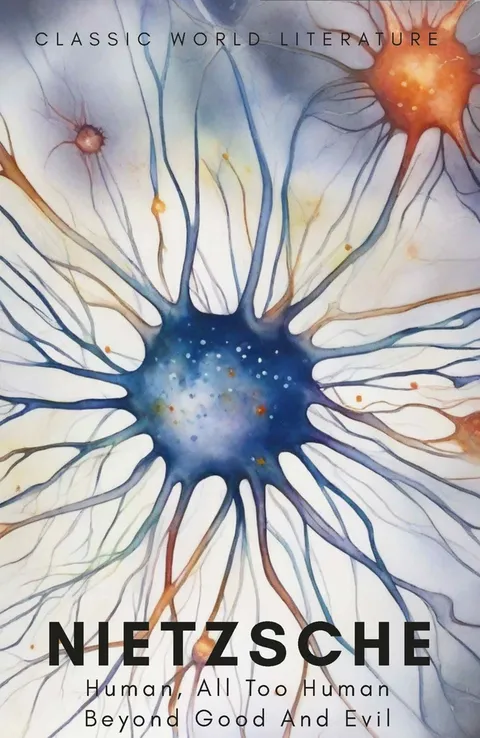
Human, All Too Human & Beyond Good and Evil
Report an issue
Tell us what's wrong and we'll take a look.
Thanks – we got it. We'll review and follow up if needed.
Human, All Too Human (1878) marks the point where Nietzsche abandons German romanticism for the French Enlightenment. At a moment of crisis in his life (no longer a friend of Richard Wagner, forced to leave academic life through ill health), he sets out his views in a scintillating and bewildering series of aphorisms which contain the seeds of his later philosophy (e.g. the will to power, the need to transcend conventional Christian morality). The result is one of the cornerstones of his life's work. It well deserves its subtitle 'A Book for Free Spirits', and its original dedication to Voltaire, whose project of radical enlightenment here finds a new champion.
Beyond Good and Evil (1886) is a scathing and powerful critique of philosophy, religion and science. Here Nietzsche presents us with problems and challenges that are as troubling as they are inspiring, while at the same time outlining the virtues, ideas, and practices which will characterise the philosophy of the future. Relentless, energetic, tirelessly probing, he both determines that philosophy's agenda and is himself the embodiment of the type of thought he wants to foster.
Friedrich Nietzsche
Friedrich Nietzsche (1844-1900) was a German philosopher and philologist whose best-known works include Thus Spoke Zarathustra; Ecce Homo; Human, All Too Human; and Beyond Good and Evil. Much of his work is characterized by radical questioning of the value and objectivity of truth and criticism of traditional ideals of morality. Nietzsche's writings were significant influences on the existentialist, nihilist, and postmodernist schools of thought, as well as on the work of such later writers as Herman Hesse, Albert Camus, Sigmund Freud, and Jean-Paul Sartre.
More by Friedrich Nietzsche





Why Readwise Books?
Readwise Books is an ebook & audiobook platform that automatically logs how much you and your friends read, making it fun and easy to read more. Learn more →