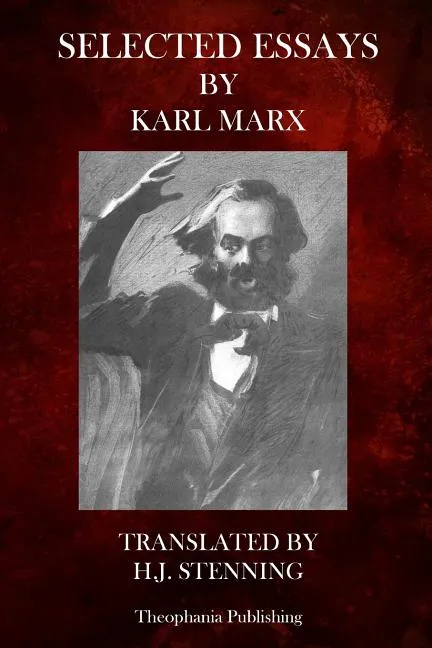
Selected Essays by Karl Marx
Report an issue
Tell us what's wrong and we'll take a look.
Thanks – we got it. We'll review and follow up if needed.
Thank you for checking out this book by Theophania Publishing. We appreciate your business and look forward to serving you soon. We have thousands of titles available, and we invite you to search for us by name, contact us via our website, or download our most recent catalogues. The present volume consists of a translation of some of Karl Marx's principal writings during the six years 1844-1850. In 1843 Marx was twenty-five years old. He had just married, apparently on the strength of the modest salary he was to receive for editing, jointly with Arnold Ruge, a periodical called the Deutsch-Französische Jahrbücher (Franco-German Annuals), the purpose of which was to promote the union of German philosophy with French social science. Only one double-number of this journal appeared in 1844. It contained Marx's criticism of the Hegelian Philosophy of Right and his exposition of the social significance of the Jewish question, in the form of a review of two works by Bruno Bauer. Translations of both articles are given in this volume. They possess a special interest for the Marxian student, as they exhibit the grafting of a materialist philosophy upon the idealist philosophy of Hegel, and show the employment of the Hegelian dialectic in the investigation of political and historical questions. It was not long before Marx and Ruge became intellectually estranged, and the third essay, The King of Prussia and Social Reform, which appeared in the Paris socialist journal Vorwärts, contains a severe polemic against Ruge. In the same organ Marx published an elaborate defence of Engels in particular and communists in general from the strictures of Karl Heinzen, a radical republican politician. In both essays Marx ranges over a wide field, and develops his own views upon economic, political and historical questions. The essay on Proudhon emphasizes the special merits of that writer as a pioneer of economic criticism, and forms a counterweight to Marx's devastating criticism of Proudhon in the Poverty of Philosophy. This piece and the sketch of French materialism are extracted from Die Heilige Familie (The Holy Family), a comprehensive work of satirical criticism, in which Marx and Engels (whose share in writing the book was a very small one), settled accounts with their philosophic conscience. The critique of the views of M. Guizot upon the English and French middle-class revolutions appeared in the Neue Rhenische Revue (New Rhenish Review), a periodical which Marx and Engels edited from London in 1850.
Karl Marx
Karl Marx was born in 1818, in the Rhenish city of Trier, the son of a successful lawyer. He studied law and philosophy at the universities of Bonn and Berlin, completing his doctorate in 1841. In Paris three years later, Marx was introduced to the study of political economy by a former fellow student, Frederick Engels. In 1848 they collaborated in writing The Communist Manifesto. Expelled from Prussia in the same year, Marx took up residence first in Paris and then in London where, in 1867 he published his magnum opus Capital. A co-founder of the International Workingmen's Association in 1864, Marx died in London in 1883.
More by Karl Marx



Why Readwise Books?
Readwise Books is an ebook & audiobook platform that automatically logs how much you and your friends read, making it fun and easy to read more. Learn more →