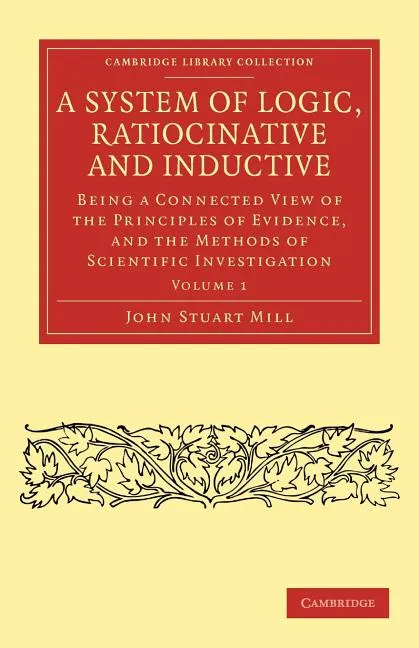
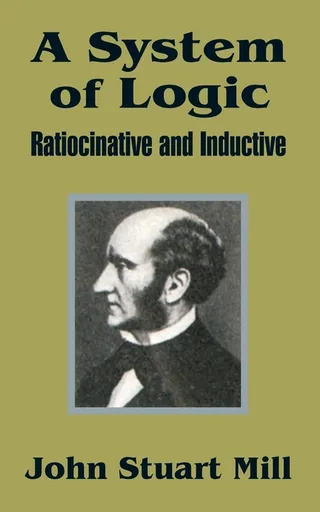
A System of Logic, Ratiocinative and Inductive - Volume 1
Report an issue
Tell us what's wrong and we'll take a look.
Thanks – we got it. We'll review and follow up if needed.
This two-volume work, first published in 1843, was John Stuart Mill's first major book. It reinvented the modern study of logic and laid the foundations for his later work in the areas of political economy, women's rights and representative government. In clear, systematic prose, Mill (1806-73) disentangles syllogistic logic from its origins in Aristotle and scholasticism and grounds it instead in processes of inductive reasoning. An important attempt at integrating empiricism within a more general theory of human knowledge, the work constitutes essential reading for anyone seeking a full understanding of Mill's thought. Volume 1 contains Mill's introduction, which elaborates upon his definition of logic as 'not the science of Belief, but the science of Proof, or Evidence'. It also features discussions of the central components of logical reasoning - propositions and syllogisms - in relation to Mill's theories of inductive reasoning and experimental method.
John Stuart Mill
John Stuart Mill was an English philosopher, politician and economist most famous for his contributions to the theory of utilitarianism. The author of numerous influential political treatises, Mill’s writings on liberty, freedom of speech, democracy and economics have helped to form the foundation of modern liberal thought. His 1859 work, On Liberty, is particularly noteworthy for helping to address the nature and limits of the power of the state over the individual. Mills has become one of the most influential figures in nineteenth-century philosophy, and his writings are still widely studied and analyzed by scholars. Mills died in 1873 at the age of 66.
More by John Stuart Mill









Why Readwise Books?
Readwise Books is an ebook & audiobook platform that automatically logs how much you and your friends read, making it fun and easy to read more. Learn more →