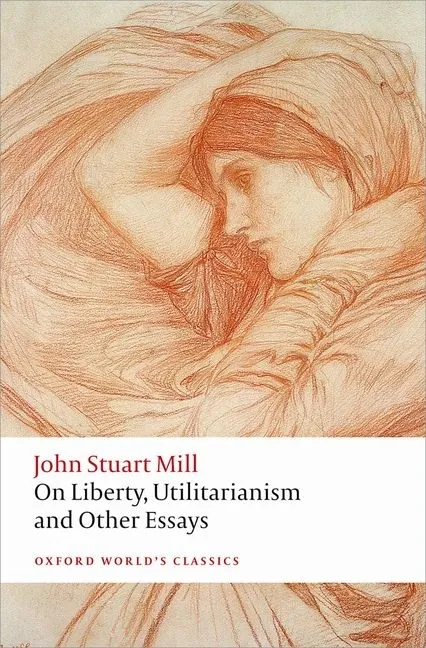
On Liberty, Utilitarianism and Other Essays
Report an issue
Tell us what's wrong and we'll take a look.
Thanks – we got it. We'll review and follow up if needed.
Mill's four essays, 'On Liberty', 'Utilitarianism', 'Considerations on Representative Government', and 'The Subjection of Women' examine the most central issues that face liberal democratic regimes - whether in the nineteenth century or the twenty-first. They have formed the basis for many of the political institutions of the West since the late nineteenth century, tackling as they do the appropriate grounds for protecting individual liberty, the basic principles of ethics, the benefits and the costs of representative institutions, and the central importance of gender equality in society.
These essays are central to the liberal tradition, but their interpretation and how we should understand their connection with each other are both contentious. In their introduction Mark Philp and Frederick Rosen set the essays in the context of Mill's other works, and argue that his conviction in the importance of the development of human character in its full diversity provides the core to his liberalism and to any defensible account of the value of liberalism to the modern world.
ABOUT THE SERIES:
For over 100 years Oxford World's Classics has made available the widest range of literature from around the globe. Each affordable volume reflects Oxford's commitment to scholarship, providing the most accurate text plus a wealth of other valuable features, including expert introductions by leading authorities, helpful notes to clarify the text, up-to-date bibliographies for further study, and much more.
John Stuart Mill
John Stuart Mill was an English philosopher, politician and economist most famous for his contributions to the theory of utilitarianism. The author of numerous influential political treatises, Mill’s writings on liberty, freedom of speech, democracy and economics have helped to form the foundation of modern liberal thought. His 1859 work, On Liberty, is particularly noteworthy for helping to address the nature and limits of the power of the state over the individual. Mills has become one of the most influential figures in nineteenth-century philosophy, and his writings are still widely studied and analyzed by scholars. Mills died in 1873 at the age of 66.
More by John Stuart Mill









Why Readwise Books?
Readwise Books is an ebook & audiobook platform that automatically logs how much you and your friends read, making it fun and easy to read more. Learn more →