Report an issue
Tell us what's wrong and we'll take a look.
Thanks – we got it. We'll review and follow up if needed.
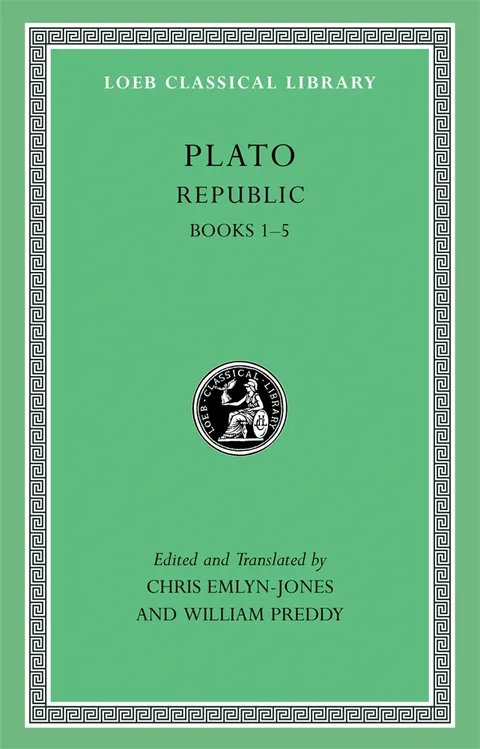
The Platonic ideal of government.
Plato of Athens, who laid the foundations of the Western philosophical tradition and in range and depth ranks among its greatest practitioners, was born to a prosperous and politically active family ca. 427 BC. In early life an admirer of Socrates, Plato later founded the first institution of higher learning in the West, the Academy, among whose many notable alumni was Aristotle. Traditionally ascribed to Plato are thirty-six dialogues developing Socrates' dialectic method and composed with great stylistic virtuosity, together with thirteen letters.
Republic, a masterpiece of philosophical and political thought, concerns righteousness both in individuals and in communities, and proposes an ideal state organized and governed on philosophical principles. This edition, which replaces the original Loeb edition by Paul Shorey, offers text, translation, and annotation that are fully current with modern scholarship. The Loeb Classical Library edition of Plato is in twelve volumes.



Christopher Emlyn-Jones
Translated by
Chris Emlyn-Jones is Emeritus Professor of Classical Studies, The Open University, United Kingdom.
William Preddy
Translated by
William Preddy is Retired Head of Classics, Oakham School, Rutland, United Kingdom.


Why Readwise Books?
Readwise Books is an ebook & audiobook platform that automatically logs how much you and your friends read, making it fun and easy to read more. Learn more →