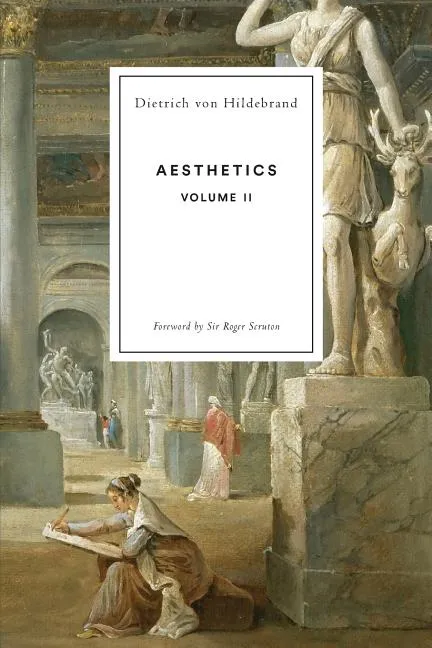
Aesthetics Volume II
Report an issue
Tell us what's wrong and we'll take a look.
Thanks – we got it. We'll review and follow up if needed.
With the release of Aesthetics Volume II, the Hildebrand Press introduces English readers to a major new work of philosophical aesthetics.
Written in the early 1970s during the last years of his life, as if harvesting a lifetime of reflection, Dietrich von Hildebrand's Aesthetics is a uniquely encompassing work.
The first volume develops an original theory of the beautiful, and the second applies that theory with tremendous breadth and attention to the various types of artwork and to many of the world's most beloved works of art.
It is a testament to the work's broad significance that two of the most respected voices in contemporary aesthetics have joined together to offer forewords to each volume: Dang Gioia to Volume I, and Sir Roger Scruton to Volume II.
Sir Roger Scruton writes on Volume II: "In this second volume of his treatise on the subject Hildebrand assembles the results of a lifetime's thought about the arts, and expresses his devotion to beauty in terms that the reader will find immediately engaging."
He continues: "Most philosophers of aesthetics content themselves with a few examples from the realm of art, and make no attempt to explore the distinct disciplines or to catalogue all the parts that contribute to the overall aesthetic effect. One purpose of this second volume, however, is to show the completeness of the artistic enterprise, and the way in which it penetrates human life in its entirety, so that the idea of beauty enters our practical activity at every point."
Dietrich von Hildebrand's Aesthetics occupies a place in the great philosophical aesthetic tradition of Plato, Kant, and Hegel, while incorporating the fresh and fundamental insights of phenomenology. With this publication of the first English translation, Dietrich von Hildebrand becomes a contemporary spokesman and defender of the importance of beauty and aesthetic values at a time when many think that beauty is relative and art unnecessary.
Dietrich Von Hildebrand
Dietrich von Hildebrand (1889-1977), born in Florence, was the son of renowned German sculptor Adolf von Hildebrand. A leading student of the philosophers Edmund Husserl and Max Scheler, he took up the "great questions"-about truth, freedom, conscience, community, love, beauty-with a freshness that allowed him to break new ground, especially in ethics, but also in epistemology, social philosophy, and aesthetics. His conversion to Catholicism in 1914 was the decisive turning point of his life and the impetus for important religious works. His opposition to Hitler and Nazism was so outspoken that he was forced to flee Germany in 1933, and later across Europe, finally settling in New York City in 1940, where he taught at Fordham University until 1960. He was the author of dozens of books, in both German and English. He was a major forerunner of Vatican II through his seminal writings on marriage, on Christian philosophy, and on the evil of anti-Semitism.
More by Dietrich Von Hildebrand
John Henry Crosby
Translated by
John Henry Crosby is a translator, writer, musician, and cultural entrepreneur. He is the founder and director of the Dietrich von Hildebrand Legacy Project, which fosters deep cultural renewal through publications, events, fellowships, and online resources that draw on the continuing vitality of Dietrich von Hildebrand's thought and witness.


Why Readwise Books?
Readwise Books is an ebook & audiobook platform that automatically logs how much you and your friends read, making it fun and easy to read more. Learn more →