Report an issue
Tell us what's wrong and we'll take a look.
Thanks – we got it. We'll review and follow up if needed.
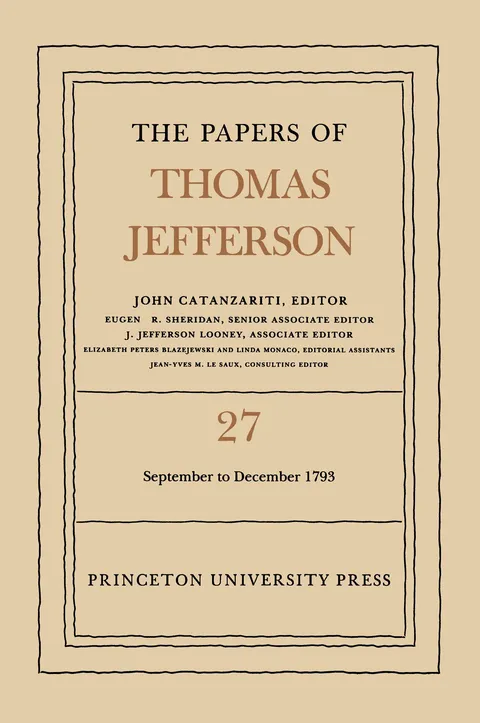
This volume brings to a close Jefferson's increasingly stormy tenure as Secretary of State, documenting, among many things, his epochal duel with Treasury Secretary Alexander Hamilton over the conduct of American foreign policy. Against the background of the deadly yellow fever in Philadelphia, he copes with obstreperous French consuls and informs Edmond Charles Genet that the American government has requested his recall. After resuming his work on the definition of U.S. maritime limits, Jefferson prevails upon President Washington to inform Congress not only of Genet's recall but also of the British refusal to carry out the disputed provisions of the Treaty of Paris. In a final effort to implement his policy of commercial retaliation against Great Britain, Jefferson submits to Congress in December his long-awaited Report on Commerce, vividly detailing the various forms of discrimination imposed on American trade by the British. The volume presents the early and final versions of the in all their textual complexity. Disappointed by Washington's tepid response to his criticisms of Hamilton's fiscal policies, frustrated by the Treasury Secretary's rising influence over American foreign policy, and eager to enjoy uninterruptedly the pleasures of domestic life, Jefferson retires from office on 31 December 1793, determined never again to suffer the torments of public life.
Volume 27 contains a supplement that covers some 270 documents for the period 1764-93 that have been found or reclassified since the publication of the last supplement in Volume 15.
Thomas Jefferson
The Constitution of the United States (ratified 1788) established the framework of the federal government and remains the supreme law of the land. The Bill of Rights and subsequent amendments define individual liberties and expand constitutional interpretation. The Declaration of Independence (1776) articulates the principles underlying the formation of the nation, while the Articles of Confederation (ratified 1781) represent the first structure of national governance prior to the Constitution.
More by Thomas Jefferson















Why Readwise Books?
Readwise Books is an ebook & audiobook platform that automatically logs how much you and your friends read, making it fun and easy to read more. Learn more →