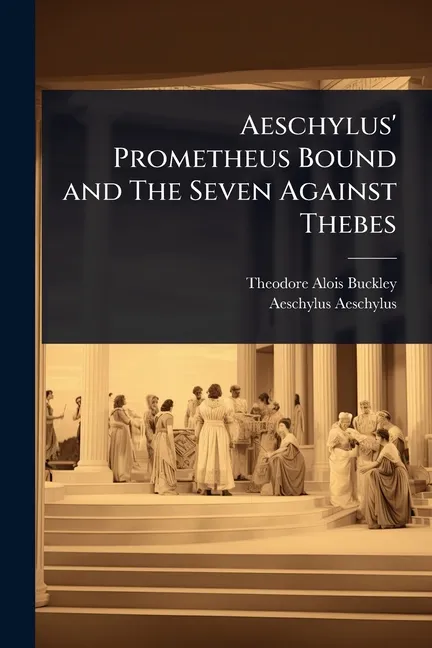
Aeschylus' Prometheus Bound and The Seven Against Thebes
Report an issue
Tell us what's wrong and we'll take a look.
Thanks – we got it. We'll review and follow up if needed.
This volume contains two iconic tragedies by Aeschylus: "Prometheus Bound" and "The Seven Against Thebes." "Prometheus Bound" explores the themes of rebellion, divine tyranny, and the plight of the individual against overwhelming power. The play centers on Prometheus, a Titan who defies Zeus by giving fire to humanity and suffers eternal punishment as a result.
"The Seven Against Thebes" is a powerful drama focused on the conflict between Eteocles and Polynices, the sons of Oedipus, as they battle for control of Thebes. This play delves into themes of fate, family strife, and the destructive nature of war. Together, these works offer a profound insight into the world of ancient Greek tragedy, showcasing Aeschylus' masterful use of language, dramatic structure, and philosophical inquiry. This edition allows readers to engage with these enduring classics in a modern context.
This work has been selected by scholars as being culturally important, and is part of the knowledge base of civilization as we know it. This work was reproduced from the original artifact, and remains as true to the original work as possible. Therefore, you will see the original copyright references, library stamps (as most of these works have been housed in our most important libraries around the world), and other notations in the work.
This work is in the public domain in the United States of America, and possibly other nations. Within the United States, you may freely copy and distribute this work, as no entity (individual or corporate) has a copyright on the body of the work.
As a reproduction of a historical artifact, this work may contain missing or blurred pages, poor pictures, errant marks, etc. Scholars believe, and we concur, that this work is important enough to be preserved, reproduced, and made generally available to the public. We appreciate your support of the preservation process, and thank you for being an important part of keeping this knowledge alive and relevant.



Aeschylus Aeschylus
Aeschylus was an ancient Greek playwright, often called the father of tragedy, whose work is considered the foundation of Greek theater. Born in Eleusis, Greece, his influence on the genre of tragedy is profound, as much of the academic knowledge of early Greek tragedy comes from his plays. Aeschylus is credited with transforming drama by introducing the second actor and expanding the scope of the stage. His plays are among the earliest surviving examples of Greek tragedy, providing crucial insights into the genre's origins. He was the son of Euphorion of Eleusis and had siblings Ameinias of Athens, Cynaegirus, and Philopatho. Aeschylus had two children, Euphorion and Euaeon, who also had connections to the theatrical arts. His works often explored themes of divine justice, fate, and the moral complexities faced by individuals. Aeschylus' contributions to the development of tragedy significantly shaped the future of theater and influenced the works of later playwrights.
More by Aeschylus Aeschylus




Why Readwise Books?
Readwise Books is an ebook & audiobook platform that automatically logs how much you and your friends read, making it fun and easy to read more. Learn more →