ULYSSES by James Joyce
Report an issue
Tell us what's wrong and we'll take a look.
Thanks – we got it. We'll review and follow up if needed.
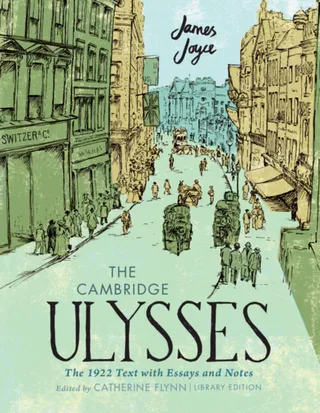
Ulysses is James Joyce's modernist masterpiece, tracing a single day-16 June 1904-in Dublin while radically expanding the formal possibilities of the novel. Structured as a loose contemporary parallel to Homer's Odyssey, the book follows Leopold Bloom, Stephen Dedalus, and Molly Bloom through ordinary routines shaped by memory, desire, and interior reflection. Joyce employs a continuously shifting range of narrative techniques, from interior monologue and free indirect discourse to parody, pastiche, and stylistic experiment, allowing each episode to adopt its own linguistic and structural logic. The result is a work that renders consciousness itself as narrative material, attentive to the texture of thought, sensation, and association.
At once intimate and encyclopedic, Ulysses stands as a central work of twentieth-century literature. Its influence extends across fiction, criticism, and cultural history, not only for its technical daring but for its insistence that everyday life can sustain the highest ambitions of art.
James Joyce
James Joyce was born in Dublin in 1882. He came from a reasonably wealthy family which, predominantly because of the recklessness of Joyce's father John, was soon plunged into financial hardship. The young Joyce attended Clongowes College, Belvedere College and, eventually, University College, Dublin. In 1904 he met Nora Barnacle, and eloped with her to Croatia. From this point until the end of his life, Joyce lived as an exile, moving from Trieste to Rome, and then to Zurich and Paris. His major works are Dubliners (1914), A Portrait of the Artist as a Young Man (1916), Ulysses (1922) and Finnegan's Wake (1939). He died in 1941, by which time he had come to be regarded as one of the greatest novelists the world ever produced.
More by James Joyce


Why Readwise Books?
Readwise Books is an ebook & audiobook platform that automatically logs how much you and your friends read, making it fun and easy to read more. Learn more →