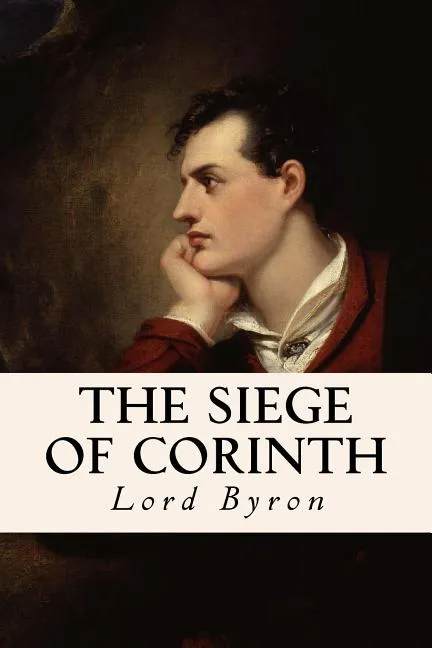
The Siege of Corinth
Report an issue
Tell us what's wrong and we'll take a look.
Thanks – we got it. We'll review and follow up if needed.
The Siege of Corinth is a rhymed, tragic narrative poem by Lord Byron. Published in 1816, it was inspired by the Ottoman massacre of the Venetian garrison holding the Acrocorinth - an incident in the Ottoman conquest of Morea during the Ottoman-Venetian Wars. Byron recounts the final, desperate resistance of the Venetians on the day the Ottoman army stormed Acrocorinth: revealing the closing scenes of the conflict through the eyes of Alp (a Venetian renegade fighting for the Ottomans) and Francesca (the beautiful maiden daughter of the governor of the Venetian garrison: Minotti). Alp - whose impassioned suit for Francesca's hand had been previously refused by Minotti - had later fled the Venetian Empire after being falsely denounced by anonymous accusers via the infamous "Lion's Mouth" at the Doge's palace (see insert). Enlisting under the Turkish flag, he repudiates both his nationality and his religion, as well as his old name 'Lanciotto', only to be challenged by Francesca herself the night before the final assault to repent his apostasy, to forgive his accusers, and to save the Venetian garrison from certain slaughter. Alp's ensuing moral dilemma: viz. to forgive those who unjustly accused him and save the lives of his enemies; or to prosecute his revenge on Venice using all the Turkish forces under his command - forms the climax of the unfolding drama as the battle between the Ottomans and the Venetians presses to its conclusion.
George Gordon Byron
Lord Byron was an English poet and the most infamous of the English Romantics, glorified for his immoderate ways in both love and money. Benefitting from a privileged upbringing, Byron published the first two cantos of Childe Harold’s Pilgrimage upon his return from his Grand Tour in 1811, and the poem was received with such acclaim that he became the focus of a public mania. Following the dissolution of his short-lived marriage in 1816, Byron left England amid rumours of infidelity, sodomy, and incest.
In self-imposed exile in Italy Byron completed Childe Harold and Don Juan. He also took a great interest in Armenian culture, writing of the oppression of the Armenian people under Ottoman rule; and in 1823, he aided Greece in its quest for independence from Turkey by fitting out the Greek navy at his own expense.
Two centuries of references to, and depictions of Byron in literature, music, and film began even before his death in 1824.
More by George Gordon Byron









Why Readwise Books?
Readwise Books is an ebook & audiobook platform that automatically logs how much you and your friends read, making it fun and easy to read more. Learn more →