Report an issue
Tell us what's wrong and we'll take a look.
Thanks – we got it. We'll review and follow up if needed.
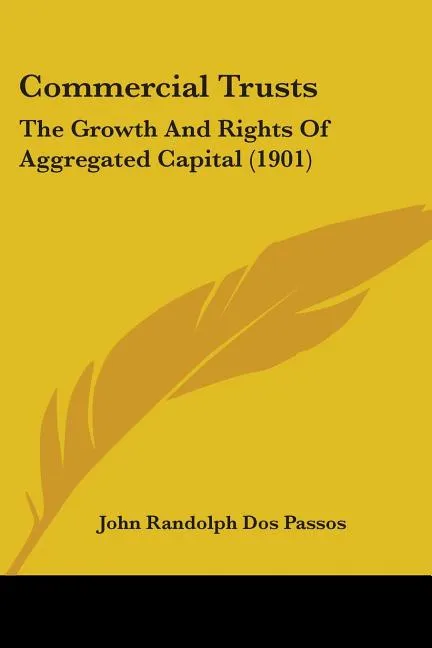
""Commercial Trusts: The Growth And Rights Of Aggregated Capital"" is a book written by John Randolph Dos Passos and published in 1901. The book explores the rise of commercial trusts in America during the late 19th century and their impact on the economy and society. Dos Passos examines the legal and economic aspects of trusts, discussing their formation, structure, and function. He also delves into the political and social implications of trusts, including their effects on competition, labor, and consumer welfare. The book is a comprehensive study of the phenomenon of commercial trusts and provides valuable insights into the history of American capitalism.An Argument Delivered Before The Industrial Commission At Washington, D. C., December 12, 1899.This scarce antiquarian book is a facsimile reprint of the old original and may contain some imperfections such as library marks and notations. Because we believe this work is culturally important, we have made it available as part of our commitment for protecting, preserving, and promoting the world's literature in affordable, high quality, modern editions, that are true to their original work.
John Dos Passos
John Roderigo Dos Passos (1896-1970) was an American novelist, painter, and member of the Lost Generation who came of age during World War I. His books include Manhattan Transfer, U.S.A. (The 42nd Parallel, 1919, and The Big Money), and Mr. Wilson's War. He is considered one of the leading novelists of his day and his pioneering works of nonlinear fiction exerted an enormous influence on the work of Jean-Paul Sartre, Mary McCarthy, and John Brunner, among others. By the time of his death in 1970 Dos Passos had written forty-two novels and numerous poems, essays, and plays, and created more than four hundred pieces of art.
More by John Dos Passos











Why Readwise Books?
Readwise Books is an ebook & audiobook platform that automatically logs how much you and your friends read, making it fun and easy to read more. Learn more →