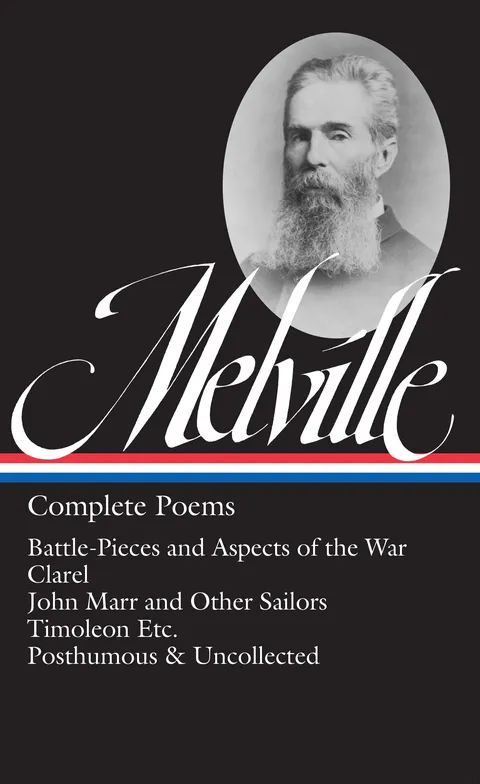
Herman Melville: Complete Poems (LOA #320)
Battle-Pieces and Aspects of the War / Clarel / John Marr and Other Sailors / Timoleon / Posthumous & Uncollected
Report an issue
Tell us what's wrong and we'll take a look.
Thanks – we got it. We'll review and follow up if needed.
An unprecedented single-volume edition of one of America's greatest poets, released to celebrate his bicentennial
Best known today for his novels and stories, the author of Moby-Dick was a devoted and accomplished poet. Ranging from Civil War battlefields to the haunted byways of the Holy Land, from close observation of nature to deep philosophical mediation, Melville's poetry was central to his life and art and he justly ranks with Whitman and Dickinson as one of America's three greatest 19th-century poets. Complete here for the first time in the fourth and final installment in the Library of America's Herman Melville edition, are all four books of poetry he published in his lifetime plus uncollected poems and the poems from two projected volumes left unfinished at the time of his death, allowing readers to appreciate for themselves the extraordinary range of his poetic achievement.
Melville's first book of poetry, Battle-Pieces (1866), remains one of the very few great American books to have emerged from the Civil War. Dedicated to the Union dead, it is both a deeply philosophical work of mourning and a fascinating record of events, tracking campaigns and battles and the war's immediate aftermath. With a cast of characters surpassing that of Moby-Dick, the epic poem Clarel (1876), about an American divinity student's pilgrimage to the Holy Land, has been likened to Paradise Lost and The Waste Land as a profound exploration of the problem of belief. Also included in Complete Poems are the two privately issued books John Marr (1888) and Timoleon (1891), which contain some of Melville's finest lyric verse. Rounding out the volume are the extraordinary poems from his two unfinished manuscripts, Weeds and Wildings and Parthenope, along with miscellaneous uncollected poems. All of the poems are presented in the authoritative Northwestern-Newberry texts.
Herman Melville
Herman Melville was born in 1819 in New York City. After his father's death he left school for a series of clerical jobs before going to sea as a young man of nineteen. At twenty-one he shipped aboard the whaler Acushnet and began a series of adventures in the South Seas that would last for three years and form the basis for his first two novels, Typee and Omoo. Although these two novels sold well and gained for Melville a measure of fame, nineteenth-century readers were puzzled by the experiments with form that he began with his third novel, Mardi, and continued brilliantly in his masterpiece, Moby-Dick. During his later years spent working as a customs inspector on the New York docks, Melville published only poems, compiled in a collection entitled Battle-Pieces, and died in 1891 with Billy Budd, Sailor, now considered a classic, still unpublished.
More by Herman Melville


Why Readwise Books?
Readwise Books is an ebook & audiobook platform that automatically logs how much you and your friends read, making it fun and easy to read more. Learn more →