Penal Philosophy
Report an issue
Tell us what's wrong and we'll take a look.
Thanks – we got it. We'll review and follow up if needed.
During his lifetime and for decades after, the writings of the French magistrate and scholar Gabriel Tarde exercised considerable influence in Europe, and the United States, extending to such diverse fields as social theory, political philosophy, and psychology. Yet Tarde's intellectual accomplishments also merit honorable status in the history of criminology, where the focus of his labors was the attempt to forge a compromise between classical jurisprudence and positivism. Tarde creatively applied a general system of social psychological theory to crime and penality. He led the struggle against Lombrosian criminal anthropology and against the scientism of Franco-Belgian moral statisticians. He also participated in well-publicized and occasionally quite acrimonious debates with ?mile Durkheim about the supposed normality of crime. His ideas are difficult to grasp. The reader of Penal Philosophy may discover in any of its nine chapters a diversity of subjects attacked with different modes of reasoning supported by contradictory discursive techniques. Tarde's literary style is frequently convoluted, although sometimes quite elegant. It is often irritatingly polemical and even obscure. Nevertheless, within this volume one can discern that the several strands of Tarde's criminology are in fact complementary approaches to a common goal, namely, the procurement of an acceptable "neo-classical" basis for criminal responsibility and punishment. Tarde constructs a sociological explanation of crime in which the individual is ultimately the principal actor, and suggests forms of penalty whose principles avoided the determinist implications of positivism. In these ways, Tarde's Penal Philosophy helped to forge the dominant features of neoclassical jurisprudence. This book will be of keen interest to students of criminology, jurisprudence, and sociology.
Gabriel De Tarde
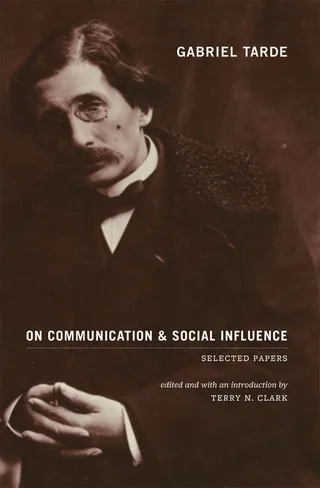
Gabriel Tarde was a French sociologist, criminologist, and social psychologist (born 12 March 1843; died 13 May 1904). He believed that little psychological exchanges between people are the foundation of sociology. He was hired as a contemporary philosophy professor at the Collège de France in 1900. He was therefore the most well-known contemporary opponent of Durkheim's sociology. He corresponded with members of the newly established criminal anthropology in the 1880s, particularly Enrico Ferri and Cesare Lombroso. Tarde eventually rose to prominence as the top criminologist from a ""French school."" Among the ideas, Tarde pioneered were the collective mind (which Gustave Le Bon picked up and refined) and economic psychology, where he foresaw a lot of contemporary trends. Émile Durkheim's work received harsh criticism from Tarde at both the methodological and theoretical levels. Durkeim and his disciples scorned and immediately disregarded his ideas as ""metaphysics,"" and they went on to mainly create sociology as a ""science."" He criticized Cesare Lombroso's formulation of the atavistic criminal theory. As part of a larger process of repetition compulsion, Tarde underlined the criminal's propensity to go back to the scene of the crime and repeat it. He emphasized the value of the creative role model in society and claimed that ""genius is the power to generate one's own children.""
More by Gabriel De Tarde











Why Readwise Books?
Readwise Books is an ebook & audiobook platform that automatically logs how much you and your friends read, making it fun and easy to read more. Learn more →