Report an issue
Tell us what's wrong and we'll take a look.
Thanks – we got it. We'll review and follow up if needed.
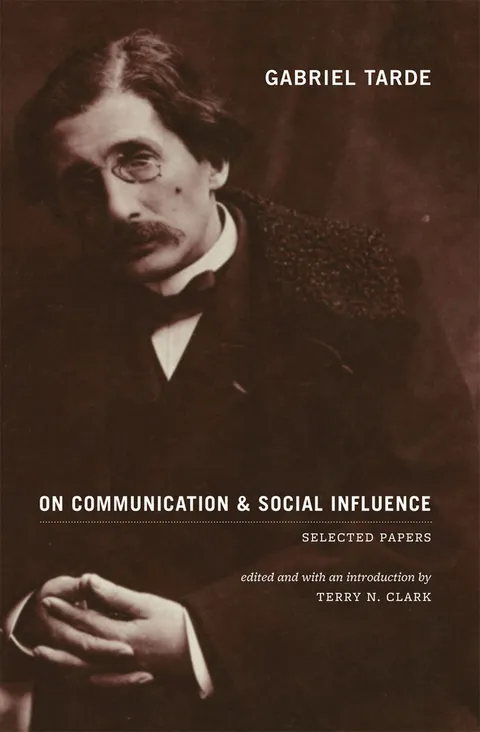
Gabriel Tarde ranks as one of the most outstanding sociologists of nineteenth-century France, though not as well known by English readers as his peers Comte and Durkheim. This book makes available Tarde's most important work and demonstrates his continuing relevance to a new generation of students and thinkers.
Tarde's landmark research and empirical analysis drew upon collective behavior, mass communications, and civic opinion as elements to be explained within the context of broader social patterns. Unlike the mass society theorists that followed in his wake, Tarde integrated his discussions of societal change at the macrosocietal and individual levels, anticipating later twentieth-century thinkers who fused the studies of mass communications and public opinion research.
Terry N. Clark's introduction, considered the premier guide to Tarde's opus, accompanies this important work, reprinted here for the first time in forty years.
Gabriel De Tarde
Gabriel Tarde was a French sociologist, criminologist, and social psychologist (born 12 March 1843; died 13 May 1904). He believed that little psychological exchanges between people are the foundation of sociology. He was hired as a contemporary philosophy professor at the Collège de France in 1900. He was therefore the most well-known contemporary opponent of Durkheim's sociology. He corresponded with members of the newly established criminal anthropology in the 1880s, particularly Enrico Ferri and Cesare Lombroso. Tarde eventually rose to prominence as the top criminologist from a ""French school."" Among the ideas, Tarde pioneered were the collective mind (which Gustave Le Bon picked up and refined) and economic psychology, where he foresaw a lot of contemporary trends. Émile Durkheim's work received harsh criticism from Tarde at both the methodological and theoretical levels. Durkeim and his disciples scorned and immediately disregarded his ideas as ""metaphysics,"" and they went on to mainly create sociology as a ""science."" He criticized Cesare Lombroso's formulation of the atavistic criminal theory. As part of a larger process of repetition compulsion, Tarde underlined the criminal's propensity to go back to the scene of the crime and repeat it. He emphasized the value of the creative role model in society and claimed that ""genius is the power to generate one's own children.""
More by Gabriel De Tarde






Why Readwise Books?
Readwise Books is an ebook & audiobook platform that automatically logs how much you and your friends read, making it fun and easy to read more. Learn more →