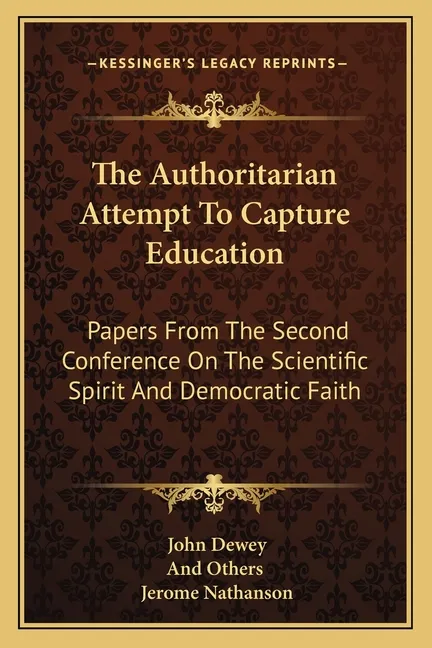
The Authoritarian Attempt To Capture Education
Papers From The Second Conference On The Scientific Spirit And Democratic Faith
Report an issue
Tell us what's wrong and we'll take a look.
Thanks – we got it. We'll review and follow up if needed.
The book ""The Authoritarian Attempt To Capture Education: Papers From The Second Conference On The Scientific Spirit And Democratic Faith"" by John Dewey is a collection of papers presented at a conference that was held in 1931. The book focuses on the authoritarian attempt to control education and how it affects the scientific spirit and democratic faith. The papers discuss how education should be free from authoritarian control and how it should promote the scientific spirit and democratic values. John Dewey, one of the most influential philosophers of the 20th century, contributed to the book with his paper titled ""The Need for a Recovery of Philosophy"". This book is a must-read for anyone interested in education, philosophy, and politics. It provides valuable insights into the challenges of maintaining a free and democratic education system in the face of authoritarianism.This scarce antiquarian book is a facsimile reprint of the old original and may contain some imperfections such as library marks and notations. Because we believe this work is culturally important, we have made it available as part of our commitment for protecting, preserving, and promoting the world's literature in affordable, high quality, modern editions, that are true to their original work.
John Dewey
John Dewey was the most famous teacher of philosophy in the early twentieth century, and he was known for his lifelong work to reform America’s educational system. Dewey was born in Burlington, Vermont, in 1859 to strict Calvinist parents. After graduating from the University of Vermont, Dewey taught high school and studied philosophy in his spare time. He finished his doctorate degree at Johns Hopkins University and continued to teach at various universities around the country, finally landing at Columbia University. While in New York, Dewey became involved in political groups and founded what would become the progressive education movement, which purported that students should learn to think for themselves to become active participants of a democratic society. He was also a founding member of the NAACP and ACLU. At this time, Dewey was influenced by Karl Marx, and after traveling to different countries to study their educational systems, praised Soviet education and came under scrutiny in the United States. Dewey continued his political and philosophical efforts until his death in 1952.
More by John Dewey














Why Readwise Books?
Readwise Books is an ebook & audiobook platform that automatically logs how much you and your friends read, making it fun and easy to read more. Learn more →