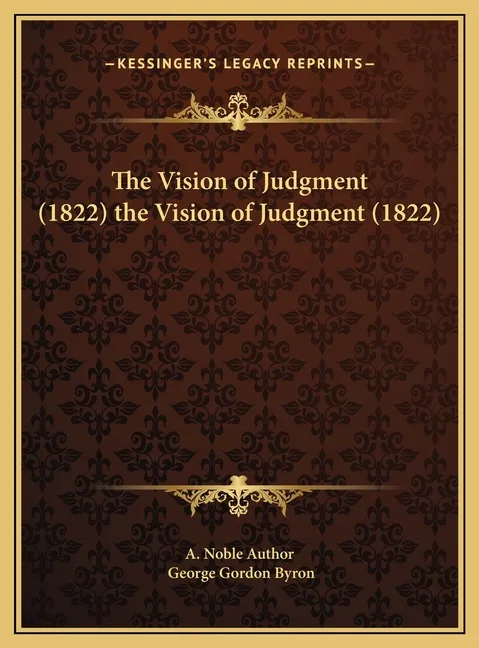
The Vision of Judgment (1822) the Vision of Judgment (1822)
Report an issue
Tell us what's wrong and we'll take a look.
Thanks – we got it. We'll review and follow up if needed.
The Vision of Judgment is a satirical poem written by a noble author in 1822. The poem is a response to the death of King George III, who was widely praised for his piety and moral character. The author takes a critical approach to the idea of divine judgment, imagining a farcical scene in which Saint Peter is overwhelmed by the sheer number of souls clamoring to be admitted to heaven. The poem is notable for its irreverent tone, mocking the idea of divine intervention in human affairs and questioning the legitimacy of religious authority. Despite its controversial subject matter, The Vision of Judgment has been praised for its wit and literary skill, and remains a significant work in the history of English literature.This scarce antiquarian book is a facsimile reprint of the old original and may contain some imperfections such as library marks and notations. Because we believe this work is culturally important, we have made it available as part of our commitment for protecting, preserving, and promoting the world's literature in affordable, high quality, modern editions, that are true to their original work.
Lord Byron
Lord Byron was an English poet and the most infamous of the English Romantics, glorified for his immoderate ways in both love and money. Benefitting from a privileged upbringing, Byron published the first two cantos of Childe Harold’s Pilgrimage upon his return from his Grand Tour in 1811, and the poem was received with such acclaim that he became the focus of a public mania. Following the dissolution of his short-lived marriage in 1816, Byron left England amid rumours of infidelity, sodomy, and incest.
In self-imposed exile in Italy Byron completed Childe Harold and Don Juan. He also took a great interest in Armenian culture, writing of the oppression of the Armenian people under Ottoman rule; and in 1823, he aided Greece in its quest for independence from Turkey by fitting out the Greek navy at his own expense.
Two centuries of references to, and depictions of Byron in literature, music, and film began even before his death in 1824.
More by Lord Byron







Why Readwise Books?
Readwise Books is an ebook & audiobook platform that automatically logs how much you and your friends read, making it fun and easy to read more. Learn more →