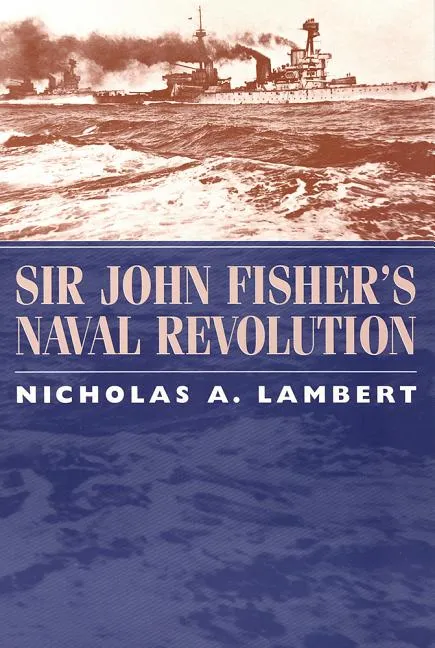
Sir John Fisher's Naval Revolution
Report an issue
Tell us what's wrong and we'll take a look.
Thanks – we got it. We'll review and follow up if needed.
An award winning account of British Naval Policy before World War I
For most of the twentieth century, historians have thought that British naval policy was driven by the Anglo-German arms race. After examining a prodigious quantity of primary sources, Nicholas A. Lambert concludes that Admiralty decision-making was in fact driven by factors unrelated to the German building program. Winner of the Society for Military History's 2000 Distinguished Book Award, Sir John Fisher's Naval Revolution explores the intrigue and negotiations between the Admiralty and leading domestic politicians and social reformers of the day, such as Herbert H. Asquith, David Lloyd George, and Winston Churchill. Lambert also explains how Great Britain's naval leaders responded to these non-military, cultural challenges under the direction of Admiral Sir John Fisher, the service head of the Admiralty from 1904 to 1910, who believed in a radically new approach to naval defense. For mainly political reasons, however, Fisher concealed his "military technological revolution" and worked surreptitiously to create a new model fleet capable of protecting all of Britain's imperial interests across the globe
Nicholas A Lambert
Nicholas Lambert is a naval historian and a leading authority on the strategic implications of globalization. He received his B.A. with a double major in economics and in history, his M.A. in history and economics, and his D.Phil. in modern history from Worcester College, University of Oxford. Afterwards, he held an Olin Fellowship at Yale University. In addition to The Neptune Factor: Alfred Thayer Mahan and the Concept of $ea Power (Naval Institute Press, 2023), he has written three other research monographs: Planning Armageddon: British Economic Warfare and the First World War (Harvard University Press, 2012), in which he pioneered the concept of weaponizing the infrastructure of the global trading system, and which was awarded the Norman B. Tomlinson Prize; The War Lords and the Gallipoli Disaster: How Globalized Trade Led Britain to its Worst Defeat of the First World War (Oxford University Press, 2021), which was awarded the John Lyman Prize; and Sir John Fisher's Naval Revolution (University of South Carolina Press, 1999), which received both the Norman B. Tomlinson Prize and the Society for Military History's Distinguished Book Award. He is also the author of twenty research articles in leading journals. His most recent commentary has appeared in Wall Street Journal and the Proceedings of the US Naval Institute.
Lambert resides outside Philadelphia with his family, having previously lived in Washington, DC, as well as India, Taiwan, and Australia. From 2016 to 2018, he held the 'Class of 1957 Distinguished Chair in Naval Heritage' at the US Naval Academy, and is privileged to be an honorary member of the Class of '57
More by Nicholas A Lambert


Why Readwise Books?
Readwise Books is an ebook & audiobook platform that automatically logs how much you and your friends read, making it fun and easy to read more. Learn more →