Report an issue
Tell us what's wrong and we'll take a look.
Thanks – we got it. We'll review and follow up if needed.
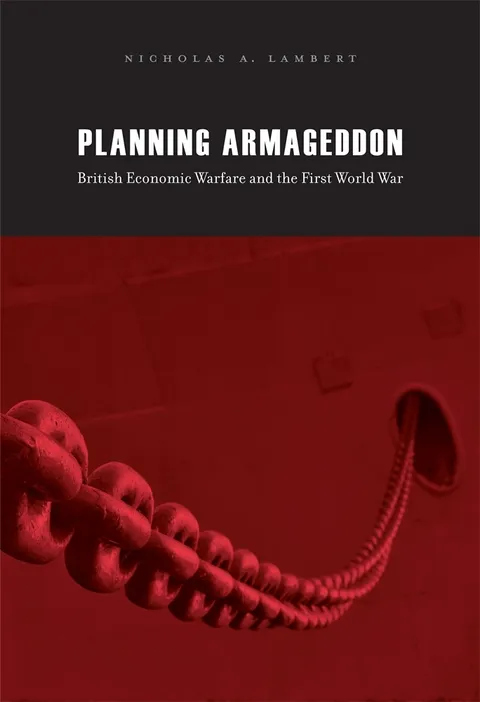
Before the First World War, the British Admiralty conceived a plan to win rapid victory in the event of war with Germany-economic warfare on an unprecedented scale.This secret strategy called for the state to exploit Britain's effective monopolies in banking, communications, and shipping-the essential infrastructure underpinning global trade-to create a controlled implosion of the world economic system.
In this revisionist account, Nicholas Lambert shows in lively detail how naval planners persuaded the British political leadership that systematic disruption of the global economy could bring about German military paralysis. After the outbreak of hostilities, the government shied away from full implementation upon realizing the extent of likely collateral damage-political, social, economic, and diplomatic-to both Britain and neutral countries. Woodrow Wilson in particular bristled at British restrictions on trade. A new, less disruptive approach to economic coercion was hastily improvised. The result was the blockade, ostensibly intended to starve Germany. It proved largely ineffective because of the massive political influence of economic interests on national ambitions and the continued interdependencies of all countries upon the smooth functioning of the global trading system.
Lambert's interpretation entirely overturns the conventional understanding of British strategy in the early part of the First World War and underscores the importance in any analysis of strategic policy of understanding Clausewitz's "political conditions of war."
Nicholas A Lambert
Nicholas Lambert is a naval historian and a leading authority on the strategic implications of globalization. He received his B.A. with a double major in economics and in history, his M.A. in history and economics, and his D.Phil. in modern history from Worcester College, University of Oxford. Afterwards, he held an Olin Fellowship at Yale University. In addition to The Neptune Factor: Alfred Thayer Mahan and the Concept of $ea Power (Naval Institute Press, 2023), he has written three other research monographs: Planning Armageddon: British Economic Warfare and the First World War (Harvard University Press, 2012), in which he pioneered the concept of weaponizing the infrastructure of the global trading system, and which was awarded the Norman B. Tomlinson Prize; The War Lords and the Gallipoli Disaster: How Globalized Trade Led Britain to its Worst Defeat of the First World War (Oxford University Press, 2021), which was awarded the John Lyman Prize; and Sir John Fisher's Naval Revolution (University of South Carolina Press, 1999), which received both the Norman B. Tomlinson Prize and the Society for Military History's Distinguished Book Award. He is also the author of twenty research articles in leading journals. His most recent commentary has appeared in Wall Street Journal and the Proceedings of the US Naval Institute.
Lambert resides outside Philadelphia with his family, having previously lived in Washington, DC, as well as India, Taiwan, and Australia. From 2016 to 2018, he held the 'Class of 1957 Distinguished Chair in Naval Heritage' at the US Naval Academy, and is privileged to be an honorary member of the Class of '57
More by Nicholas A Lambert


Why Readwise Books?
Readwise Books is an ebook & audiobook platform that automatically logs how much you and your friends read, making it fun and easy to read more. Learn more →