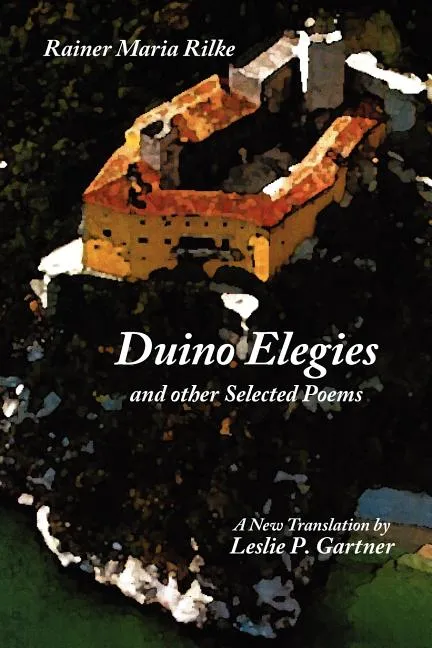
Duino Elegies and Other Selected Poems
Report an issue
Tell us what's wrong and we'll take a look.
Thanks – we got it. We'll review and follow up if needed.
Duino Elegies are the ten magnificent poems that defined the Austrian poet, Rainer Maria Rilke's artistic vision of life, death, eternity, and the human condition. Marie von Thurn und Taxis-Hohenlohe invited Rilke to stay at her castle in Duino, on the coast of the Adriatic Sea near Trieste. He stayed alone in the castle for about four months and, on a cold day in January, 1912, when he was contemplating how to answer a business letter that he received, he walked out into the freezing windy morning and, walking along a path by the bastions looking down at the violent waves of the Adriatic a couple of hundred feet below him, he heard someone speak, but when he turned around, he was alone and the voice that he heard spoke the famous opening lines of the First Elegy: "Wer, wenn ich schriee, hörte mich denn aus der Engel/ Ordnungen?" ("Who, if I cried out, would hear me among the Angelic/ Orders?"). Dr. Gartner presents a new translation of Rilke's magnum opus as well as of a selection of ten famous poems from Rilke's collected works.
Rainer Maria Rilke
Rainer Maria Rilke (1975-1926) was born in Prague and traveled throughout Europe, returning frequently to Paris, where he wrote his finest works: the two volumes of New Poems and the great modernist novel The Notebooks of Malte Laurids Brigge. He lived the last years of his life in Switzerland, where he completed his two poetic masterworks, the Duino Elegies and Sonnets to Orpheus. Joel Agee has translated Elias Canetti, Friedrich Dürenmatt, and Gottfried Benn. He won the Helen and Kurt Wolff Translator's Prize for his work on Heinrich von Kleist's verse play Penthesilea. He is the author of Twelve Years: An American Boyhood in East Germany.
More by Rainer Maria Rilke







Why Readwise Books?
Readwise Books is an ebook & audiobook platform that automatically logs how much you and your friends read, making it fun and easy to read more. Learn more →