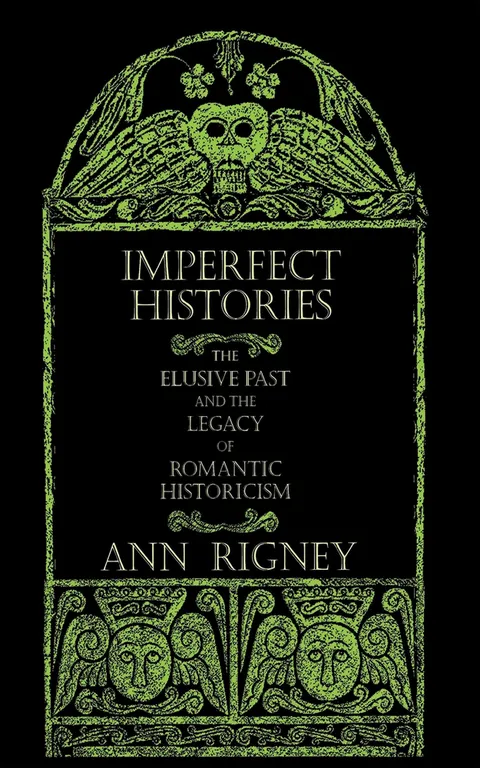
Imperfect Histories
Report an issue
Tell us what's wrong and we'll take a look.
Thanks – we got it. We'll review and follow up if needed.
Imperfect Histories puts "imperfection" at the heart of a theory of historical representation. Ann Rigney shows how historical writing involves dealing with intractable subjects that resist our efforts to know and to shape them. Those who write history, she says, engage in an ongoing struggle to match up what they find relevant in the past with the information and interpretive models at their disposal. Chronic dissatisfaction is at the heart of historical practice. This is especially evident in the various attempts made over the last two centuries to write an "alternative" history of everyday experience. Focusing on historical writing in the last decades of the eighteenth century and the first half of the nineteenth, Rigney analyzes a wide range of works by Walter Scott, Jules Michelet, Augustin Thierry, and Thomas Carlyle. She shows how the attempt to write an alternative history brought historical writing into a close yet fraught relationship with literature. The result is a new account of that relationship as it took shape in the romantic period and as it continues to influence contemporary practices.
Ann Rigney
Ann Rigney is Professor of Comparative Literature at Utrecht University. She has published widely on theories of cultural memory and on memory cultures in Europe in the 19th and 20th centuries. Her books include The Afterlives of Walter Scott (OUP, 2021) and Transnational Memory (co-edited with C. De Cesari, De Gruyter, 2014). She is Principal Investigator on the ERC-funded project Remembering Activism: The Cultural Memory of Protest in Europe (ReAct) (2019-2024).
More by Ann Rigney


Why Readwise Books?
Readwise Books is an ebook & audiobook platform that automatically logs how much you and your friends read, making it fun and easy to read more. Learn more →