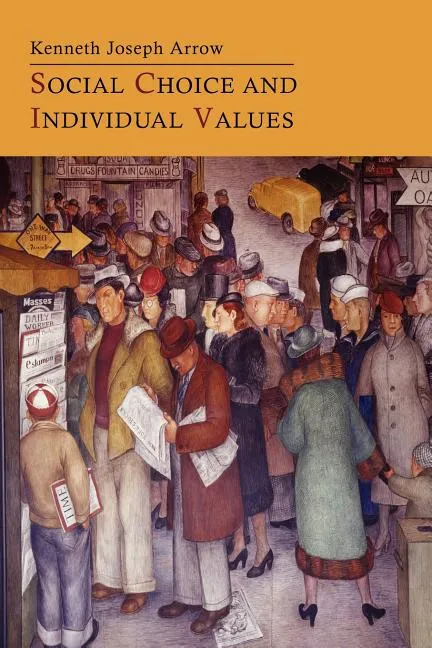
Social Choice and Individual Values
Report an issue
Tell us what's wrong and we'll take a look.
Thanks – we got it. We'll review and follow up if needed.
2012 Reprint of 1951 Edition. Exact facsimile of the original edition, not reproduced with Optical Recognition Software. Kenneth Arrow's monograph "Social Choice and Individual Values" and a theorem within it created modern social choice theory, a rigorous melding of social ethics and voting theory with an economic flavor. The work culminated in what Arrow called the "General Possibility Theorem," better known thereafter as Arrow's (impossibility) theorem. The theorem states that, absent restrictions on either individual preferences or neutrality of the constitution to feasible alternatives, there exists no social choice rule that satisfies a set of plausible requirements. The result generalizes the voting paradox, which shows that majority voting may fail to yield a stable outcome.
Kenneth J Arrow
Kenneth Arrow is the Joan Kenney Professor of Economics and Professor of Operations Research, emeritus; a CHP/PCOR fellow; and an FSI senior fellow by courtesy. He is the joint winner of the Nobel Memorial Prize in Economics with John Hicks in 1972. To date, he is the youngest person to have received this award, at 51. In economics, he is a figure in post-World War II neo-classical economic theory. Many of his former graduate students have gone on to win the Nobel Memorial Prize themselves. His most significant works are his contributions to social choice theory, notably "Arrow's impossibility theorem", and his work on general equilibrium analysis. He has also provided foundational work in many other areas of economics, including endogenous growth theory and the economics of information. He has been co-editor of the Handbooks in Economics series since the mid-1980s.
More by Kenneth J Arrow


Why Readwise Books?
Readwise Books is an ebook & audiobook platform that automatically logs how much you and your friends read, making it fun and easy to read more. Learn more →