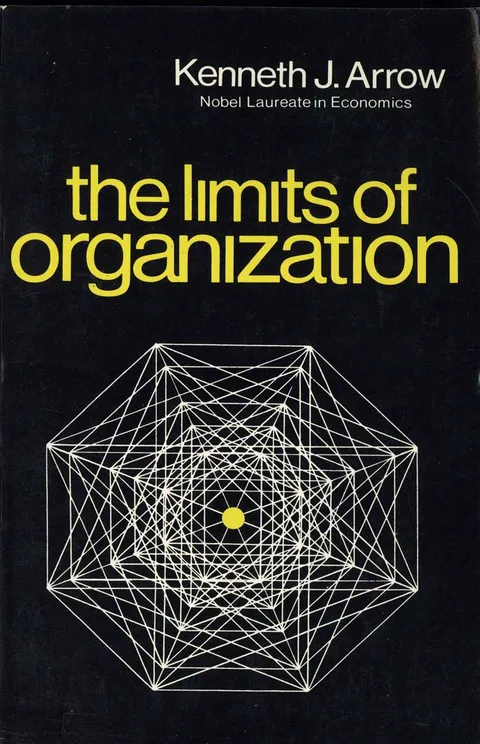
The Limits of Organization
Report an issue
Tell us what's wrong and we'll take a look.
Thanks – we got it. We'll review and follow up if needed.
The tension between what we wish for and what we can get, between values and opportunities, exists even at the purely individual level. A hermit on a mountain may value warm clothing and yet be hard-pressed to make it from the leaves, bark, or skins he can find. But when many people are competing with each other for satisfaction of their wants, learning how to exploit what is available becomes more difficult. In this volume, Nobel Laureate Kenneth J. Arrow analyzes why - and how - human beings organize their common lives to overcome the basic economic problem: the allocation of scarce resources. The price system is one means of organizing society to mediate competition, and Arrow analyzes its successes and failures. Alternative modes of achieving efficient allocation of resources are explored: government, the internal organization of the firm, and the 'invisible institutions' of ethical and moral principles. Professor Arrow shows how these systems create channels to make decisions, and discusses the costs of information acquisition and retrieval. He investigates the factors determining which potential decision variables are recognized as such. Finally, he argues that organizations must achieve some balance between the power of the decision makers and their obligation to those who carry out their decisions - between authority and responsibility.
Kenneth J Arrow
Kenneth Arrow is the Joan Kenney Professor of Economics and Professor of Operations Research, emeritus; a CHP/PCOR fellow; and an FSI senior fellow by courtesy. He is the joint winner of the Nobel Memorial Prize in Economics with John Hicks in 1972. To date, he is the youngest person to have received this award, at 51. In economics, he is a figure in post-World War II neo-classical economic theory. Many of his former graduate students have gone on to win the Nobel Memorial Prize themselves. His most significant works are his contributions to social choice theory, notably "Arrow's impossibility theorem", and his work on general equilibrium analysis. He has also provided foundational work in many other areas of economics, including endogenous growth theory and the economics of information. He has been co-editor of the Handbooks in Economics series since the mid-1980s.
More by Kenneth J Arrow







Why Readwise Books?
Readwise Books is an ebook & audiobook platform that automatically logs how much you and your friends read, making it fun and easy to read more. Learn more →