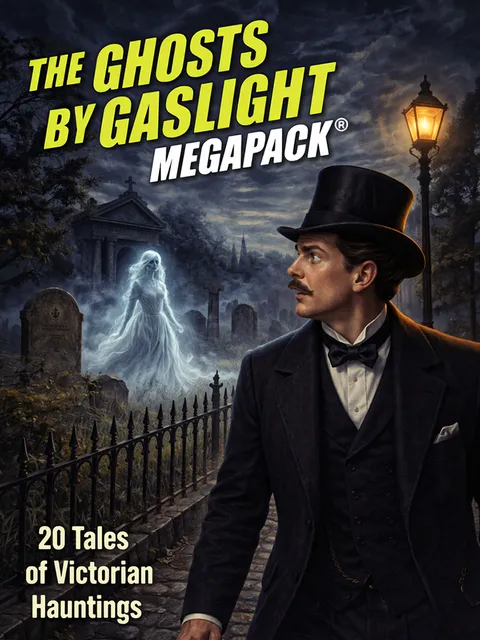
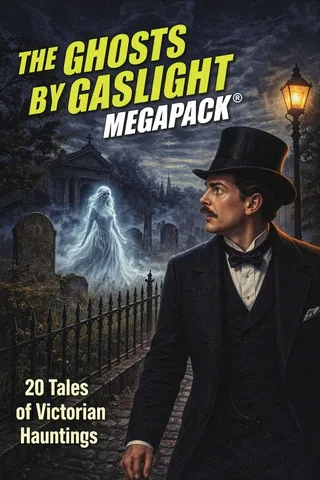
The Ghosts by Gaslight MEGAPACK®
Report an issue
Tell us what's wrong and we'll take a look.
Thanks – we got it. We'll review and follow up if needed.
<p>From fog-shrouded railway carriages to candlelit séance rooms, from haunted manor houses to snow-swept country roads, the gaslight era produced some of the finest ghost stories ever written—and many of the best have been hiding in the yellowed pages of forgotten magazines for over a century.</p>
<p>This collection gathers twenty tales of the supernatural from the Victorian and Edwardian periods, drawn from sources as varied as <i>Belgravia</i>, <i>Bentley’s Miscellany</i>, <i>Temple Bar</i>, <i>Household Words</i>, and <i>The Strand</i>. The contributors range from celebrated names—Le Fanu, H.G. Wells, W.W. Jacobs, Walter Scott, Amelia B. Edwards—to writers who vanished so thoroughly from literary history that almost nothing is known of them beyond the stories themselves.</p>
<p>Whether the ghost arrives as a cold shadow on a bedroom wall, a voice with no living source, or a shrouded figure gripping the foot of a bed, these are stories built on atmosphere, dread, and the unsettling conviction that the past is never entirely past.</p>
<p>This volume contains:</p>
<ul>
<li>"Introduction," by John Betancourt</li>
<li>"The Ghost’s Summons," by Ada Buisson</li>
<li>"The Dead Sexton," by J. Sheridan Le Fanu</li>
<li>"A Real Country Ghost Story," by Albert Smith</li>
<li>"The Open Door," by Mrs. Oliphant</li>
<li>"President d’Albi," by Anonymous</li>
<li>"The Story of the Inexperienced Ghost," by H.G. Wells</li>
<li>"Fiddle o’ Dreams," by Arthur Morrison</li>
<li>"Walnut-Tree House," by Mrs. J.H. Riddell</li>
<li>"The Spectre in the Train," by Helen</li>
<li>"The Tapestried Chamber," by Sir Walter Scott</li>
<li>"The Fourfold Dream," by James Payn</li>
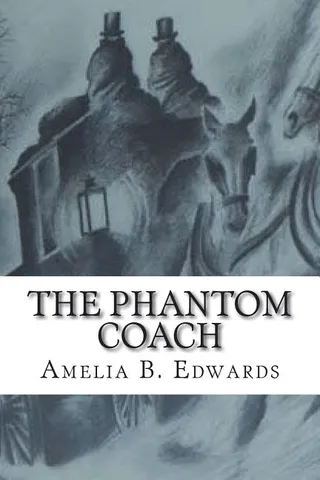
<li>"The Phantom Coach," by Amelia B. Edwards</li>
<li>"The Truth, the Whole Truth, and Nothing but the Truth," by Rhoda Broughton</li>
<li>"The Ghost Detective," by Mark Lemon</li>
<li>"The Toll-House," by W.W. Jacobs</li>
<li>"A Weird Warning," by Ronald J. McNeill</li>
<li>"No Living Voice," by Thomas Street Millington</li>
<li>"The Shadow of a Shade," by Tom Hood</li>
<li>"In the Séance Room," by Lettice Galbraith</li>
</ul>
<p>If you enjoy this entry in the best-selling MEGAPACK® series, check out the 400+ other volumes, covering mystery, fantasy, science fiction, westerns, adventure, and much, much more. Accept no pale imitation!</p>





Sheridan Le Fanu
Brown Wolf Publishing creates literary investigations, interactive casebooks, and reading companions for readers who want to question what a story leaves unsaid. Its books pair public-domain literature with original dossiers, timelines, evidence-based reading routes, and interpretive challenges for independent readers, book clubs, classrooms, and collectors of Gothic fiction.
More by Sheridan Le Fanu













W.W. Jacobs
W.W. Jacobs was a late 19th- early 20th century novelist, short story writer and playwright, best known for his horror classic, the short story "The Monkey's Paw," which was part of a collection of short fiction published in 1902 called "The Lady of the Barge." Jacobs mainly wrote humorous fiction, primarily about dockworkers and seafaring men, but he also had a taste for the macabre, writing a number of spooky and disturbing short stories. After World War I, he shifted from writing for magazines to adapting his stories for the stage. He would wind up writing eighteen plays in all, some on his own and some in collaboration with other writers. A number of his works were also adapted for the screen and Jacobs was occasionally involved in their creation as well. W.W. Jacobs died in London in 1943 at the age of seventy-nine.
More by W.W. Jacobs












Why Readwise Books?
Readwise Books is an ebook & audiobook platform that automatically logs how much you and your friends read, making it fun and easy to read more. Learn more →