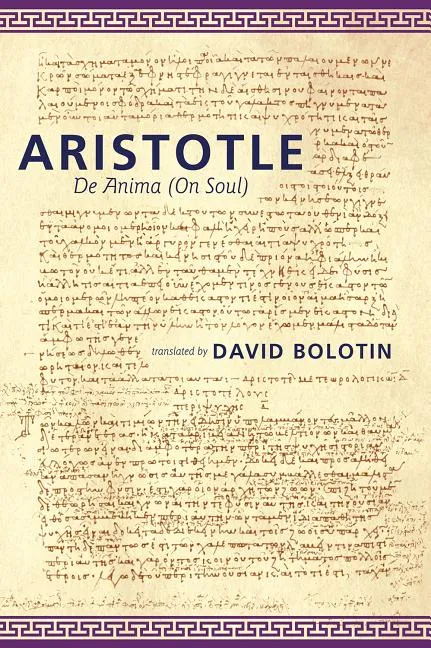
De Anima (On Soul)
Report an issue
Tell us what's wrong and we'll take a look.
Thanks – we got it. We'll review and follow up if needed.

David Bolotin's translation of Aristotle's DE ANIMA, or ON SOUL, aims above all at fidelity to the Greek. It treats Aristotle as a teacher regarding what soul really is, and hence it tries to convey the meaning--to the extent possible in English--of his every word. The translation itself is supplemented with footnotes, some of which, when taken together, sketch the outline of an overall interpretation of the work. Since Bolotin considers Aristotle to be a teacher, one who knows far more than we do about the matters he discusses, he has made a scrupulous effort to examine the manuscript tradition. And he has relied only on readings that are well-attested in the oldest manuscripts, rather than accepting conjectural emendations of modern editors, who all too often substitute a Greek text that is easy to understand for any of those that have come down to us from the ancient copyists. Bolotin's translation, though it aims at the greatest possible clarity in English, subordinates felicity of English expression to the demand for fidelity to the Greek. For readers--including those who may already know some Greek--who wish to study DE ANIMA with care, it offers access that has hitherto been unavailable in English to the precise meaning of Aristotle's text.
Aristotle
Aristotle is one of the most widely recognized Greek philosophers of the Classical period. A polymath from Ancient Greece, Aristotle was taught by Plato and is known to be the founder of the Lyceum and Aristotelian tradition.
More by Aristotle





Why Readwise Books?
Readwise Books is an ebook & audiobook platform that automatically logs how much you and your friends read, making it fun and easy to read more. Learn more →