Report an issue
Tell us what's wrong and we'll take a look.
Thanks – we got it. We'll review and follow up if needed.
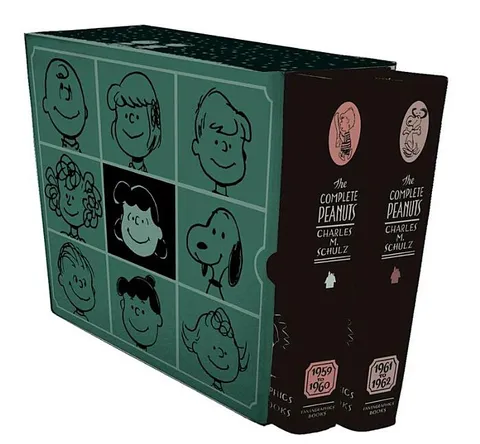
In The Complete Peanuts 1959-1960: As the first decade of Peanuts closes, it seems only fitting to bid farewell to that halcyon decade with a cover starring Patty, one of the original three Peanuts. Major new additions to classic Peanuts lore come fast and furious here. Snoopy begins to take up residence atop his doghouse, and his repertoire of impressions increases exponentially. Lucy sets up her booth and offers her first five-cent psychiatric counsel. (Her advice to a forlorn Charlie Brown: "Get over it.") For the very first time, Linus spends all night in the pumpkin patch on his lonely vigil for the Great Pumpkin (although he laments that he was a victim of "false doctrine," he's back 12 months later). Linus also gets into repeated, and visually explosive, scuffles with a blanket-stealing Snoopy, suffers the first depredations of his blanket-hating grandmother, and falls in love with his new teacher Miss Othmar. Even more importantly, several years after the last addition to the cast ("Pig-Pen"), Charlie Brown's sister Sally makes her appearance -- first as an (off-panel) brand new baby for Charlie to gush over, then as a toddler and eventually a real, talking, thinking cast member. (By the end of this volume, she'll already start developing her crush on Linus.) All this, and one of the most famous Peanuts strips ever: "Happiness is a warm puppy." Almost one hundred of the 731 strips collected in this volume (including many Sundays) have never been collected in any book since their original release, with one hundred more having been collected only once in relatively obscure and now impossible-to-find books; in other words, close to one quarter of the strips have never been seen by anyone but the most avid Peanuts completists. The introduction is by comedienne extraordinaire Whoopi Goldberg, who reveals which Peanuts character she has tattooed on her body (and where) -- as well as telling of her meeting with "Sparky" Schulz, and her fascinating theory on Snoopy's brother Spike. As always, this volume is gorgeously designed by award-winning cartoonist Seth. The Complete Peanuts continues to receive national and international media attention for its sophisticated treatment of one of the 20th Century's defining American classics.
In The Complete Peanuts 1961-1962: Launching into the 1960s, Schulz adds another new cast member. Two, in fact: The obnoxious Frieda, of "naturally curly hair" fame, and her inert, seemingly boneless cat Faron. The rapidly maturing Sally, who was after all just born in the previous volume, is ready to start kindergarten and not at all happy about it. Linus' life is particularly turbulent in this volume, as he is forced to wear glasses, sees the unexpected return of his favorite teacher, Miss Othmar, and coaxes Sally into the cult of the Great Pumpkin (with regrettable results). Snoopy, meanwhile, becomes a compulsive water sprinkler head stander, unhappily befriends a snowman or two, and endures a family crisis involving a little family of birds. Plus baseball blowouts (including a rare team victory), Beethoven birthdays, and plenty of dubious psychiatric help for a nickel. This book collects 730 daily and Sunday comic strips, the vast majority of which are not currently available in any in-print Peanuts collection, and many of which have never been reprinted since their initial appearance in papers over 50 years ago. With a new introduction by legendary jazz pianist/vocalist Diana Krall and gorgeous design by award-winning cartoonist Seth.
Charles M. Schulz
From his earliest memories, Charles M. Schulz knew that all he wanted to do was “draw funny pictures.” Schulz was born in Minneapolis, Minnesota, in 1922, and his love for cartoons was fostered by his father in a shared appreciation for the Sunday funnies. As a senior in high school, at the prompting of his mother, he completed a correspondence cartoon course with the Federal School of Applied Cartooning. Schulz continued his studies in art as the genre of the cartoon began to change—adopting simplistic, minimalistic styles that, conveniently, allowed Schulz to showcase his dry, self-effacing humor. In 1943 Schulz enlisted in the army to help the American efforts in World War II, ultimately returning home in the fall of 1945. In a push to make his dream of being a cartoonist a reality, he taught at his alma mater and sold cartoon strips to papers intermittently. Finally, in October 1950, the first Peanuts strip premiered in seven national newspapers. His seemingly simple creation—illustrations of large-headed kids using vocabulary and facing situations far beyond their years—became a well-known, well-loved comic strip and grew to have an enormous global impact. Schulz himself has won awards from his cartoonist peers, has been recognized and lauded by U.S. and foreign governments, and has received Emmys for his animated specials. In 2015 the beloved holiday TV special—A Charlie Brown Christmas—will reach its fifty-year milestone. Though the last original Peanuts comic appeared in papers on February 13, 2000, the day after Schulz passed away in his sleep, his work continues to be read in more than two thousand newspapers around the world.
More by Charles M. Schulz






Why Readwise Books?
Readwise Books is an ebook & audiobook platform that automatically logs how much you and your friends read, making it fun and easy to read more. Learn more →