Subconscious Religion
Report an issue
Tell us what's wrong and we'll take a look.
Thanks – we got it. We'll review and follow up if needed.
"Subconscious Religion" proposes that spirituality exists within the unconscious mind, separate from conscious awareness. This concept, popularized by thinkers like William James and Friedrich Schleiermacher, suggests that individuals, regardless of their religious affiliation, possess innate spiritual inclinations. These inclinations manifest through experiences like awe in nature, intuitive insights, or feelings of transcendence. While subconscious religion lacks the structured beliefs of organized faith, it emphasizes the personal and subjective nature of spirituality. Proponents argue that recognizing these unconscious spiritual experiences can enrich one's life, providing a deeper sense of meaning and interconnectedness. Critics, however, may challenge the concept's lack of empirical evidence or formal doctrines. Nevertheless, subconscious religion invites individuals to explore the depths of their consciousness and uncover hidden dimensions of their spiritual experiences, offering a unique perspective on human spirituality and existential inquiry.
Russell H Conwell
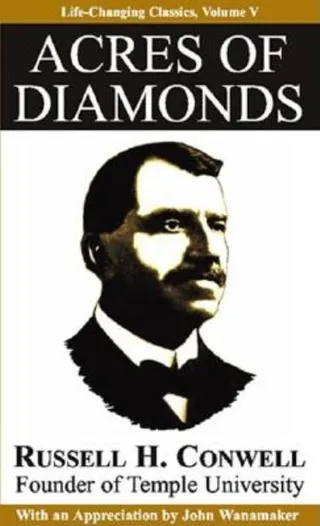
Russell Herman Conwell was born on February 15, 1843, in South Worthington, Massachusetts, to Martin Conwell and Miranda Wickham Conwell. Raised on a New England farm, he developed a strong work ethic early in life. He pursued higher education at Yale University and Albany Law School, where he gained experience in both theology and law. His early career included serving as a lawyer, journalist, and soldier during the Civil War, where he displayed leadership and resilience. After the war, he transitioned into ministry, becoming a prominent Baptist preacher known for his compelling public speaking. In Philadelphia, he served as pastor of The Baptist Temple and became a central figure in the city's spiritual and educational life. In 1884, he founded Temple College, later Temple University, aiming to provide educational opportunities to working-class individuals. His widely celebrated lecture, Acres of Diamonds, emphasized the value of finding opportunity in one's immediate surroundings. Through his philanthropy, teaching, and public service, he influenced countless lives and shaped institutions that continue today. Conwell died on December 6, 1925, in Philadelphia and was buried at the Founder's Garden, leaving a legacy grounded in faith, education, and the pursuit of self-betterment.
More by Russell H Conwell



Why Readwise Books?
Readwise Books is an ebook & audiobook platform that automatically logs how much you and your friends read, making it fun and easy to read more. Learn more →