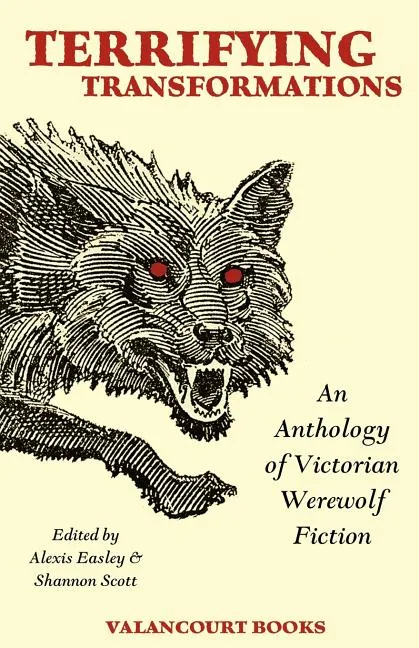
Terrifying Transformations
An Anthology of Victorian Werewolf Fiction, 1838-1896
Report an issue
Tell us what's wrong and we'll take a look.
Thanks – we got it. We'll review and follow up if needed.
This collection brings together fifteen chilling stories of lycanthropy and murder written from 1838 to 1896, all taken from their original appearances in Victorian periodicals and story collections, many of them reprinted here for the first time. This edition includes a new introduction by Alexis Easley and Shannon Scott, explanatory notes, and numerous rare Victorian werewolf illustrations.
This collection contains: "Hugues, the Wer-Wolf" (1838) by Sutherland Menzies, "The White Wolf of the Hartz Mountains" (1839) by Frederick Marryat, "A Story of a Weir-Wolf" (1846) by Catherine Crowe, excerpts from Wagner, the Wehr-Wolf (1846-47) by George W. M. Reynolds, "Lycanthropy in London; or, The Wehr-Wolf of Wilton-Crescent" (1855) by Dudley Costello, "The Gray-Wolf" (1871) by George MacDonald, "The Were-wolf of the Grendelwold" (1882) by F. Scarlett Potter, "The White Wolf of Kostopchin" (1889) by Gilbert Campbell, "A Pastoral Horror" (1890) by Arthur Conan Doyle, "The Mark of the Beast" (1890) by Rudyard Kipling, "The Were-Wolf" (1890) by Clemence Housman, "Dracula's Guest" (ca. 1892) by Bram Stoker, "The Other Side: A Breton Legend" (1893) by Eric Stenbock, "Morraha" (1894) by Joseph Jacobs, and "Where There is Nothing, There is God" (1896) by William Butler Yeats. An appendix of contextual materials is also included, featuring nonfiction articles from Victorian periodicals dealing with lycanthropy, Rosamund Marriott Watson's poem "A Ballad of the Were-wolf" (1891), excerpts from Sabine Baring-Gould's The Book of Were-Wolves (1865) and Laurence Housman's illustrations for Clemence Housman's The Were-wolf (1896).
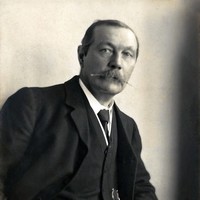
Sir Arthur Conan Doyle
Sir Arthur Conan Doyle (1859-1930) was a writer and physician most noted for his fictional stories about the detective Sherlock Holmes, the first scientific detective, which are generally considered milestones in the field of crime fiction. Before becoming a writer, he attended the University of Edinburgh to train as a physician, and it was from his teacher, Joseph Bell, that he learned much of what would inspire Holmes's skills of deduction. He also wrote science fiction stories, historical novels, plays, romances, poetry, and nonfiction. After his son Kingsley died in the first World War, he became a convert to spiritualism and a social reformer who used his investigative skills to prove the innocence of individuals.
More by Sir Arthur Conan Doyle
Rudyard Kipling
Rudyard Kipling was born in Bombay (now known as Mumbai), India, but returned with his parents to England at the age of five. Among Kipling’s best-known works are The Jungle Book, Just So Stories, and the poems “Mandalay” and “Gunga Din.” Kipling was the first English-language writer to receive the Nobel Prize for literature (1907) and was among the youngest to have received the award.
More by Rudyard Kipling




Why Readwise Books?
Readwise Books is an ebook & audiobook platform that automatically logs how much you and your friends read, making it fun and easy to read more. Learn more →