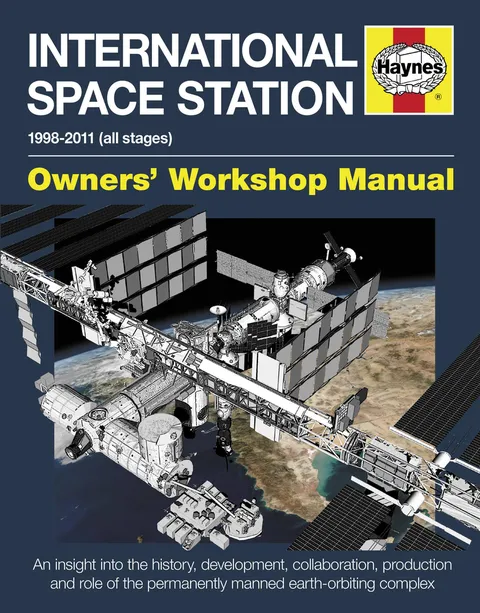
International Space Station
An Insight Into the History, Development, Collaboration, Production and Role of the Permanently Manned Earth-Orbiting Complex
Report an issue
Tell us what's wrong and we'll take a look.
Thanks – we got it. We'll review and follow up if needed.
The International Space Station (ISS) is a permanently manned earth-orbiting complex where astronauts carry out research into a wide range of scientific activities. It comprises modules built in the USA, Russia, Europe, Japan and Canada. Author David Baker examines how the ISS was built, the logistics modules and freighters operated by its user nations, how the ISS works as an integrated facility, life on board, what the ISS does, the research carried out and who benefits.
David Baker
David Baker is a history and science writer for SimonWhistler.com who holds the world's first PhD in Big History, studying under David Christian. He has delivered award-winning lectures at Macquarie University and the University of Amsterdam, is a visiting lecturer at the University of Paris-Sorbonne, and wrote the YouTube series Crash Course Big History, hosted by John and Hank Green in partnership with the Gates Big History Project. He is the author of The Shortest History of the World, and Sex.
More by David Baker








Why Readwise Books?
Readwise Books is an ebook & audiobook platform that automatically logs how much you and your friends read, making it fun and easy to read more. Learn more →