Report an issue
Tell us what's wrong and we'll take a look.
Thanks – we got it. We'll review and follow up if needed.
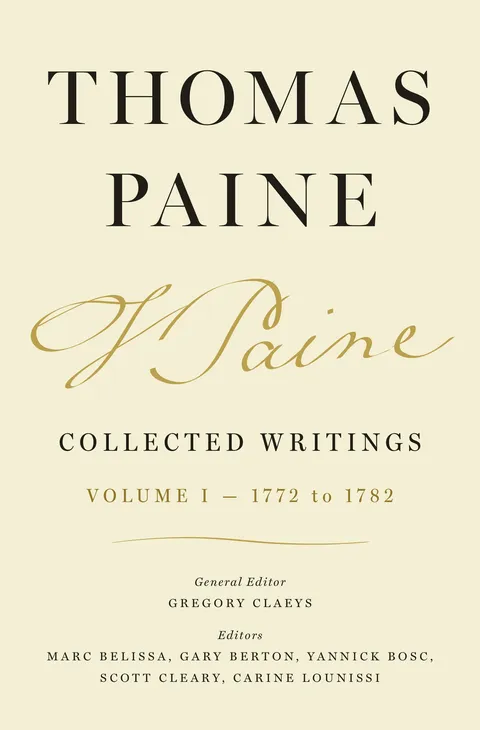
A comprehensive scholarly edition of the writings and correspondence of Thomas Paine
Thomas Paine: Collected Writings is the first major new edition of Paine’s works, bringing together all his writings in six breathtaking volumes that dramatically revise our previous understanding of his activities as a writer and his importance as a democratic theorist in the age of revolutions. It includes about 180 new letters and some two hundred works newly attributed to Paine, with twenty-nine works previously regarded as Paine’s being deattributed. Drawing on pioneering computerized text analysis that makes possible for the first time attributions of anonymous and pseudonymous texts, this collection includes in volumes 5–6 newly identified pamphlets and newspaper and journal contributions, and suggests that Paine was extremely active as a Grub Street oppositional Whig writer in the decade prior to the American Revolution. Many writings from the period of his residence in France (1792–1802) and his subsequent return to the United States are also restored to his published output. Paine emerges as a much more consistent and serious democratic theorist than is often assumed, whose contributions to revolutionary debates in America, Britain, and France were unparalleled in their time.
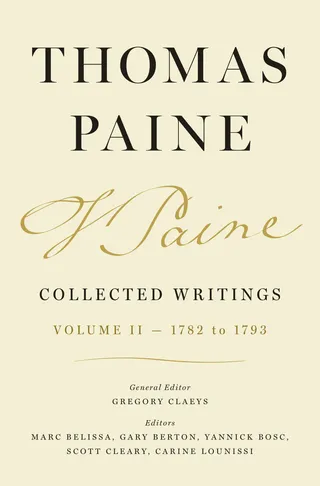
This volume spans the years 1772 to 1782, a decade that witnessed a diverse output of writings from Paine, from editorials and magazine pieces to pamphlets and newspaper articles. The book includes the Forester Letters, the Crisis papers, the Deane Affair articles, and Common Sense, with Gregory Claeys’s general introduction and commentary by the editors providing invaluable historical context.
Thomas Paine
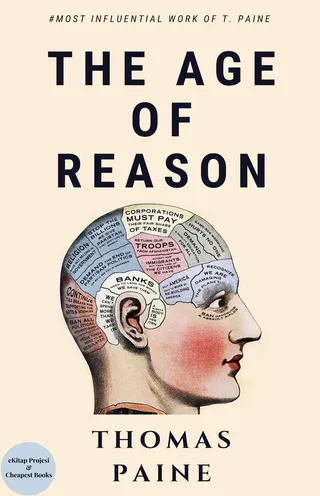
English-born Thomas Paine left behind hearth and home for adventures on the high seas at nineteen. Upon returning to shore, he became a tax officer, and it was this job that inspired him to write The Case of the Officers of Excise in 1772. Paine then immigrated to Philadelphia, and in 1776 he published Common Sense, a defense of American independence from England. After returning to Europe, Paine wrote his famous Rights of Man as a response to criticism of the French Revolution. He was subsequently labeled as an outlaw, leading him to flee to France where he joined the National Convention. However, in 1793 Paine was imprisoned, and during this time he wrote the first part of The Age of Reason, an anti-church text which would go on to be his most famous work. After his release, Paine returned to America where he passed away in 1809.
More by Thomas Paine





Why Readwise Books?
Readwise Books is an ebook & audiobook platform that automatically logs how much you and your friends read, making it fun and easy to read more. Learn more →