Report an issue
Tell us what's wrong and we'll take a look.
Thanks – we got it. We'll review and follow up if needed.
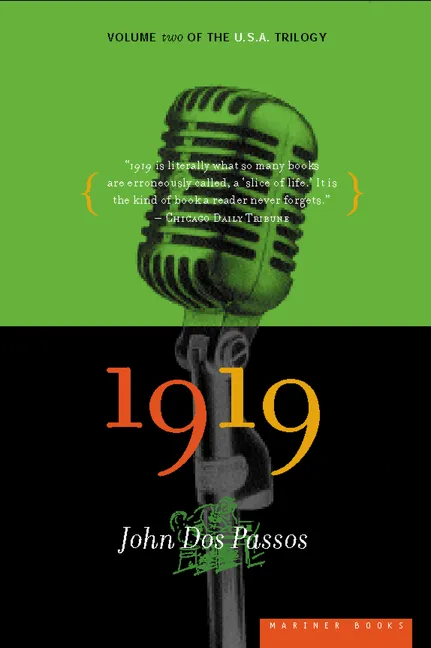
With 1919, the second volume of his U.S.A. trilogy, John Dos Passos continues his "vigorous and sweeping panorama of twentieth-century America" (Forum), lauded on publication of the first volume not only for its scope, but also for its groundbreaking style.
Again, employing a host of experimental devices that would inspire a whole new generation of writers to follow, Dos Passos captures the many textures, flavors, and background noises of modern life with a cinematic touch and unparalleled nerve.
1919 opens to find America and the world at war, and Dos Passos's characters, many of whom we met in the first volume, are thrown into the snarl. We follow the daughter of a Chicago minister, a wide-eyed Texas girl, a young poet, a radical Jew, and we glimpse Woodrow Wilson, Theodore Roosevelt, and the Unknown Soldier. 1919 provides an incomparable portrait of America from the turn of the century to the Depression of 1929.
John Dos Passos
John Roderigo Dos Passos (b.1896, d.1970) was a writer, painter, and political activist. He wrote over forty books, including plays, poetry, novels, biographies, histories, and memoirs. He crafted over four hundred drawings, watercolors, and other artworks. Dos Passos considered himself foremost a writer of contemporary chronicles. He chose the moniker of “chronicler” because he was happiest working at the edge of fiction and nonfiction. Both genres benefited from his mastery of observation—his “camera eye”—and his sense of historical context. Dos Passos sought to ground fiction in historic detail and working-class, realistic dialogue. He invented a multimedia format of newsreels, songs, biographies, and autobiography to convey the frenzy of 20th century America’s industrialism and urbanism. His most memorable fiction—Three Soldiers (1920), Manhattan Transfer (1925), U.S.A. (1938)—possesses the authority of history and the allure of myth. Likewise, he sought to vitalize nonfiction history and reportage with the colors, sounds, and smells documented on his journeys across the globe.
More by John Dos Passos





Why Readwise Books?
Readwise Books is an ebook & audiobook platform that automatically logs how much you and your friends read, making it fun and easy to read more. Learn more →