Report an issue
Tell us what's wrong and we'll take a look.
Thanks – we got it. We'll review and follow up if needed.
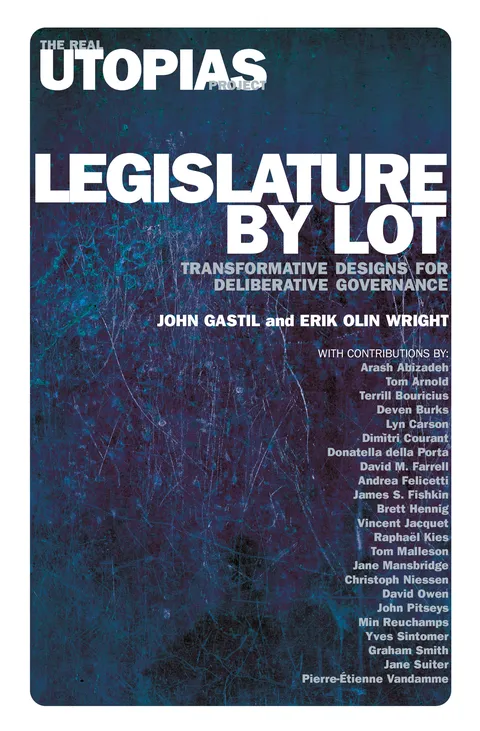
The gap between the public and its representatives might seem unbridgeable in the modern world, but Legislature by Lot examines an inspiring solution: a legislature chosen through “sortition”—the random selection of lay citizens. It’s a concept that has come to the attention of democratic reformers across the globe. Proposals for such bodies are being debated in Australia, Belgium, Iceland, the United Kingdom, and many other countries. Sortition promises to reduce corruption and create a truly representative legislature in one fell swoop.
In Legislature by Lot, John Gastil and Erik Olin Wright make the case for pairing a sortition body with an elected chamber within a bicameral legislature. Gastil is a leading deliberative democracy scholar, and Wright a distinguished sociologist and editor of the Real Utopias series, of which this is a part. In this volume, they bring together critics and advocates of sortition who have studied ancient Athens, deliberative polling, political theory, social movements, and civic innovation. Without obscuring its limitations, the contributors offer a wide variety of ideas for how to implement sortition and examine its potential for reshaping modern politics.
Legislature by Lot includes sixteen essays that respond to Gastil and Wright’s detailed proposal. Essays comparing sortition to contemporary reforms see it as a dramatic extension of deliberative “minipublics,” which gather random samples of citizens to weigh public policy dilemmas without being empowered to enact legislation. Another set of essays explores the democratic principles underlying sortition and elections and considers, for example, how a sortition body holds itself accountable to a public that did not elect it. The third set of essays considers alternative paths to democratic reform, which limit the powers of a sortition chamber or more quickly establish a pure sortition body.
With contributions by Arash Abizadeh, Tom Arnold, Terrill Bouricius, Deven Burks, Lyn Carson, Dimitri Courant, Donatella della Porta, David M. Farrell, Andrea Felicetti, James S. Fishkin, Brett Hennig, Vincent Jacquet, Raphaël Kies, Tom Malleson, Jane Mansbridge, Christoph Niessen, David Owen, John Pitseys, Min Reuchamps, Yves Sintomer, Graham Smith, Jane Suiter, and Pierre-Étienne Vandamme.
John Gastil
John Gastil is a professor in the Department of Communication Arts and Sciences at the Pennsylvania State University, where he is a senior scholar at the McCourtney Institute for Democracy. Gastil's research focuses on the theory and practice of deliberative democracy, particularly as it relates to how people behave as voters or members of small decision-making groups. Recent books he has authored or coedited include The Jury and Democracy (2010), Democracy in Motion: Evaluating the Practice and Impact of Deliberative Civic Engagement (2012), and a second edition of Democracy in Small Groups (2014).
More by John Gastil
Erik Olin Wright
Erik Olin Wright (1947-2019) was Vilas Distinguished Professor of Sociology at the University of Wisconsin. He authored many books, including Classes, Interrogating Inequality, Class Counts, Deepening Democracy (with Archon Fung), and Envisioning Real Utopias.
More by Erik Olin Wright





Why Readwise Books?
Readwise Books is an ebook & audiobook platform that automatically logs how much you and your friends read, making it fun and easy to read more. Learn more →