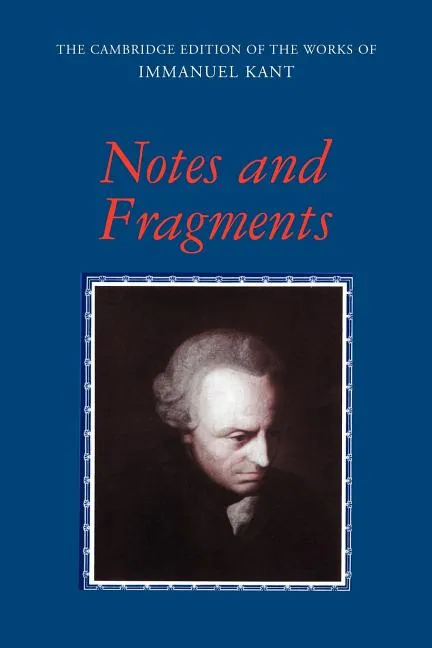
Notes and Fragments
Report an issue
Tell us what's wrong and we'll take a look.
Thanks – we got it. We'll review and follow up if needed.
This volume provides an extensive translation of the notes and fragments that survived Kant's death in 1804. These include marginalia, lecture notes, and sketches and drafts for his published works. They are important as an indispensable resource for understanding Kant's intellectual development and published works, casting fresh light on Kant's conception of his own philosophical methods and his relations to his predecessors, as well as on central doctrines of his work such as the theory of space, time and categories, the refutations of scepticism and metaphysical dogmatism, the theory of the value of freedom and the possibility of free will, the conception of God, the theory of beauty, and much more.
Immanuel Kant
Immanuel Kant (1724-1804) was a renowned German philosopher born on 22 April 1724 in Königsberg, Prussia (now Kaliningrad, Russia). He was one of the most influential thinkers of the Enlightenment and made significant contributions to philosophy, ethics, metaphysics and the theory of knowledge. He believed that human knowledge comes from both experience and reason and emphasised morality, duty, freedom and human dignity. His most famous works include Critique of Pure Reason, Critique of Practical Reason and Groundwork of the Metaphysics of Morals. He spent most of his life teaching and writing in Königsberg and died on 12 February 1804.
More by Immanuel Kant


Why Readwise Books?
Readwise Books is an ebook & audiobook platform that automatically logs how much you and your friends read, making it fun and easy to read more. Learn more →