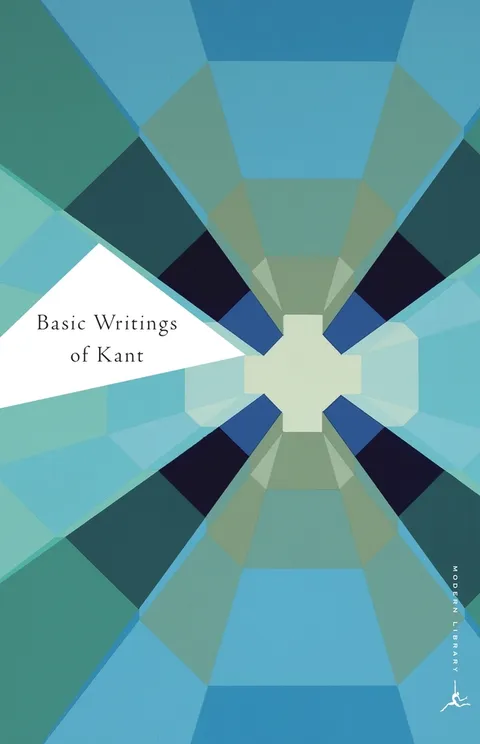
Basic Writings of Kant
Report an issue
Tell us what's wrong and we'll take a look.
Thanks – we got it. We'll review and follow up if needed.
With translations by F. Max Müller and Thomas K. Abbott
The writings of Immanuel Kant became the cornerstone of all subsequent philosophical inquiry. They articulate the relationship between the human mind and all that it encounters and remain the most important influence on our concept of knowledge. As renowned Kant scholar Allen W. Wood writes in his Introduction, Kant "virtually laid the foundation for the way people in the last two centuries have confronted such widely differing subjects as the experience of beauty and the meaning of human history." Edited and compiled by Dr. Wood, Basic Writings of Kant stands as a comprehensive summary of Kant's contributions to modern thought, and gathers together the most respected translations of Kant's key moral and political writings.
Immanuel Kant
Immanuel Kant (1724-1804) was a renowned German philosopher born on 22 April 1724 in Königsberg, Prussia (now Kaliningrad, Russia). He was one of the most influential thinkers of the Enlightenment and made significant contributions to philosophy, ethics, metaphysics and the theory of knowledge. He believed that human knowledge comes from both experience and reason and emphasised morality, duty, freedom and human dignity. His most famous works include Critique of Pure Reason, Critique of Practical Reason and Groundwork of the Metaphysics of Morals. He spent most of his life teaching and writing in Königsberg and died on 12 February 1804.
More by Immanuel Kant
F Max Muller
Translated by
Friedrich Max Muller, commonly known as F. Max Muller (1823-1900), was a German-British scholar of comparative religion and philology. He is best known for his work on the translation and interpretation of ancient texts, including the Vedas and The Dhammapada. Muller studied at the University of Berlin, where he was influenced by the philosopher Friedrich Schleiermacher and the linguist Franz Bopp. He later moved to England and became a professor of comparative philology at Oxford University, where he taught for over thirty years. Muller's work on The Dhammapada was part of a larger project to translate the sacred texts of Hinduism, Buddhism, and other religions into English. His translation of The Dhammapada is widely regarded as one of the most authoritative and accurate versions of the text. Muller was a prolific author and published numerous works on comparative religion, mythology, and language. He was also a prominent member of the Royal Asiatic Society and played an important role in the development of religious studies as a field of academic inquiry.









Why Readwise Books?
Readwise Books is an ebook & audiobook platform that automatically logs how much you and your friends read, making it fun and easy to read more. Learn more →