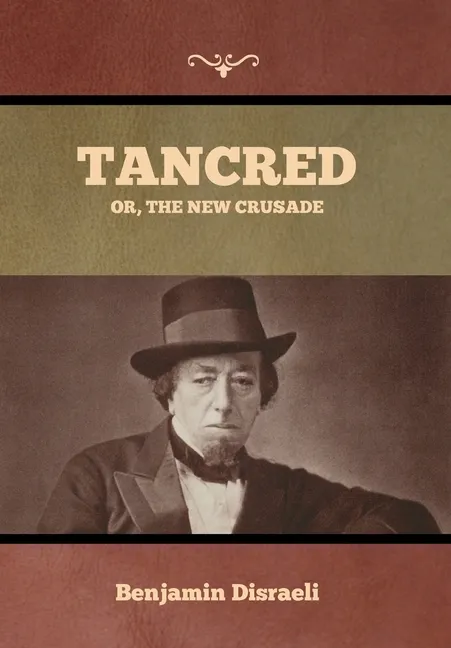
Tancred; Or, The New Crusade
Report an issue
Tell us what's wrong and we'll take a look.
Thanks – we got it. We'll review and follow up if needed.
Tancred; or, The New Crusade (1847) is a novel by Benjamin Disraeli, first published by Henry Colburn in three volumes. Together with Coningsby (1844) and Sybil (1845) it forms a sequence sometimes called the Young England trilogy. It shares a number of characters with the earlier novels, but unlike them is concerned less with the political and social condition of England than with a religious and even mystical theme: the question of how Judaism and Christianity are to be reconciled, and the Church reborn as a progressive force.
Tancred, Lord Montacute, the novel's idealistic young hero, seems destined to live the life of a conventional member of the British ruling class. Dissatisfied with his life in fashionable London circles, he instead leaves his parents and retraces the steps of his Crusader ancestors to the Holy Land, hoping there to "penetrate the great Asian mystery" and understand the roots of Christianity. He meets the beautiful Eva, daughter of a Jewish financier, and becomes involved in the political machinations of her foster-brother, the brilliant Fakredeen, a Lebanese emir. At Fakredeen's instigation Tancred is kidnapped and held captive, but is nevertheless allowed to visit Mount Sinai. He then has a vision of an angel who tells him he must be the prophet of "the sublime and solacing doctrine of theocratic equality", a concept which Disraeli leaves somewhat hazy. Tancred falls ill, and is released at the instigation of Eva, who nurses him back to health. She teaches him about the glories of Mediterranean civilization and the debt that Christianity owes to Judaism. Tancred, in love with Eva and utterly convinced that she is right, proposes marriage, but the romance is broken off when his parents appear to reclaim their son and take him back to England.
Critics noted that the novel's character, Fakredeen revealingly explores Disraeli's real self. They ask if it was coincidental that Tancred's obsession with the East and his crusade to create a new empire foreshadows the imperialism of Disraeli towards India and the Ottoman Empire in the 1870s. (wikipedia.org)
About the author:
Benjamin Disraeli, 1st Earl of Beaconsfield, KG, PC, DL, JP, FRS (21 December 1804 - 19 April 1881) was a British statesman, Conservative politician and writer who twice served as Prime Minister of the United Kingdom. He played a central role in the creation of the modern Conservative Party, defining its policies and its broad outreach. Disraeli is remembered for his influential voice in world affairs, his political battles with the Liberal Party leader William Ewart Gladstone, and his one-nation conservatism or "Tory democracy". He made the Conservatives the party most identified with the British Empire and military action to expand it, both of which were popular among British voters. He is the only British Prime Minister to have been born Jewish.
Disraeli was born in Bloomsbury, then a part of Middlesex. His father left Judaism after a dispute at his synagogue; Benjamin became an Anglican at the age of 12. After several unsuccessful attempts, Disraeli entered the House of Commons in 1837. In 1846, Prime Minister Robert Peel split the party over his proposal to repeal the Corn Laws, which involved ending the tariff on imported grain. Disraeli clashed with Peel in the House of Commons, becoming a major figure in the party. When Lord Derby, the party leader, thrice formed governments in the 1850s and 1860s, Disraeli served as Chancellor of the Exchequer and Leader of the House of Commons.
... (wikipedia.org)
Benjamin Disraeli
Benjamin Disraeli, born on December 21, 1804, was a British statesman, Conservative politician, and writer who became the Prime Minister of the United Kingdom twice. He was the son of Isaac D'Israeli, a prominent writer and historian, and Maria Basevi D'Israeli. Disraeli played a crucial role in shaping the modern Conservative Party and is best known for his political philosophy of one-nation conservatism, or Tory democracy, which emphasized social reform alongside traditional values. Disraeli's political career was marked by his rivalry with Liberal leader William Ewart Gladstone, with whom he had numerous debates and conflicts. His leadership helped strengthen Britain's global influence, particularly in imperial matters. In addition to his political career, Disraeli was an accomplished writer. His early novels, such as Vivian Grey (1826), Popanilla (1828), and The Young Duke (1831), offered satirical critiques of British society and politics. Disraeli's literary works were an important aspect of his public life, reflecting his political views and sharp social commentary. He passed away on April 19, 1881, leaving a lasting impact on both British politics and literature.
More by Benjamin Disraeli













Why Readwise Books?
Readwise Books is an ebook & audiobook platform that automatically logs how much you and your friends read, making it fun and easy to read more. Learn more →